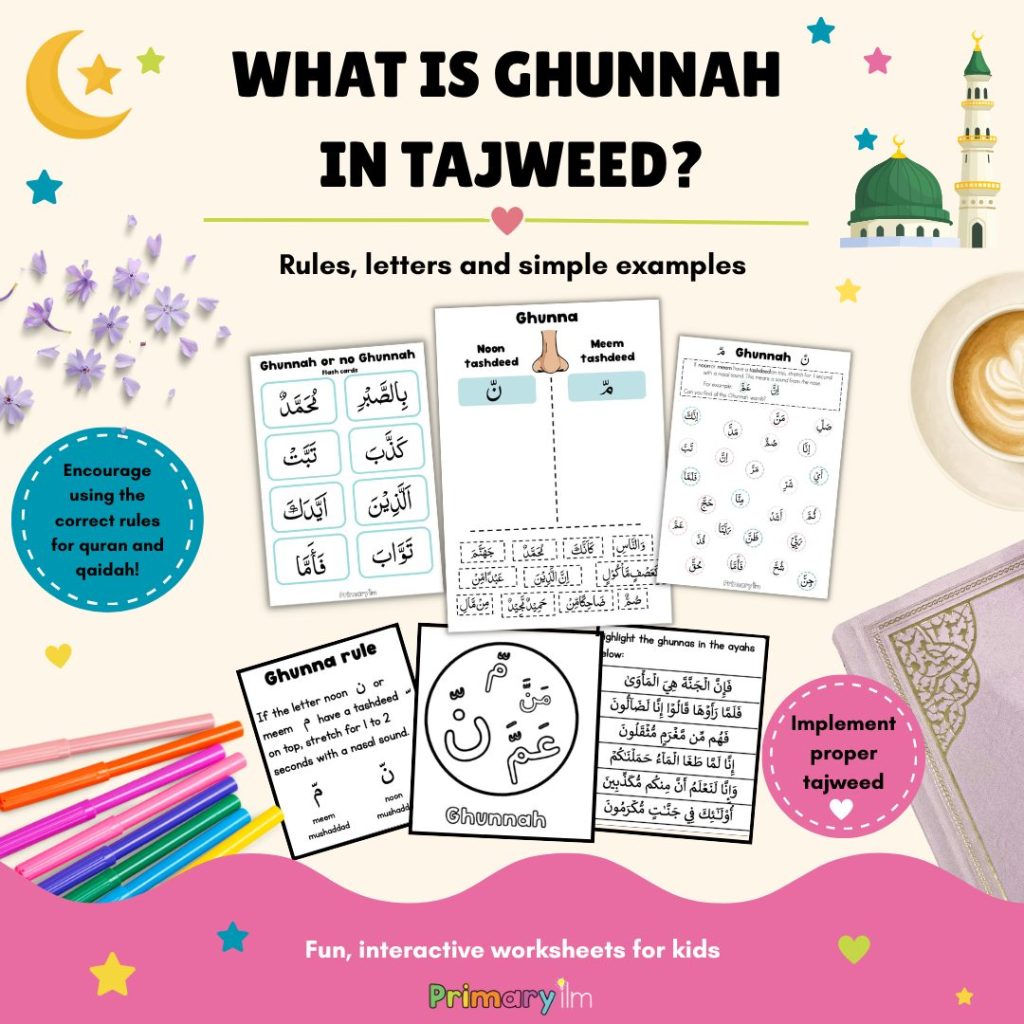
If you’ve recently started learning Tajweed, you’ve probably come across the word Ghunnah.
Alongside terms like Qalqalah, Madd and Ikhfa, Ghunnah is one of the first Tajweed rules beginners learn. While the Arabic terminology can seem unfamiliar at first, the concept itself is actually quite simple.
In this guide, we’ll explain what Ghunnah means, which letters use it, how long it lasts, and how to teach it to children in a simple and enjoyable way.
Contents
What Is Ghunnah?
What Does Ghunnah Mean?
Which Letters Have Ghunnah?
When Is Ghunnah Used?
How Long Should Ghunnah Be?
Simple Ghunnah Examples
Common Ghunnah Mistakes
How to Teach Ghunnah to Children
Ghunnah Worksheets
Frequently Asked Questions
Also included: Ghunnah Quiz
What Is Ghunnah?
Ghunnah (غُنَّة) is a soft nasal sound made through the nose while reciting certain letters of the Qur’an.
Rather than coming from the tongue or lips, the sound resonates through the nasal passage, giving the recitation its distinctive tone.
In Tajweed, Ghunnah is most commonly heard with the letters:
- ن (Noon)
- م (Meem)
When applied correctly, Ghunnah beautifies the recitation and helps preserve the pronunciation taught by the Prophet ﷺ.
What Does Ghunnah Mean?
The Arabic word Ghunnah literally means nasalisation or a humming sound.
Think of the gentle humming sound you naturally make when saying “mmm”.
Ghunnah is very similar, but instead of exaggerating the sound, it should be gentle, controlled and natural. There should be no input from the tongue.
Which Letters Have Ghunnah?
The two main Ghunnah letters are:
ن (Noon)
م (Meem)
The clearest Ghunnah occurs when either of these letters carries a Shaddah ّ
For example:
إِنَّ
ثُمَّ
In both examples, the Noon or Meem is held with a soft nasal sound.
When Is Ghunnah Used?
Although Ghunnah is strongest with Noon Mushaddadah and Meem Mushaddadah, you’ll also hear it in several other Tajweed rules.
These include:
- Ikhfa
- Idgham with Ghunnah
- Iqlab
As you continue learning Tajweed, you’ll study each of these rules in more detail.
For now, it’s enough to recognise that Ghunnah appears abundently throughout the Qur’an.
How Long Should Ghunnah Be?
One of the most common beginner questions is:
How long do I hold the Ghunnah?
In most cases, Ghunnah is held for two counts.
Your teacher may describe this as two harakah (or two beats).
It’s important not to rush the sound, but equally important not to stretch it longer than required.
With regular listening and practice, the correct timing becomes much more natural.
Simple Ghunnah Examples
Here are a few examples where you can hear Ghunnah clearly:
Example 1
إِنَّ
Notice the Noon with Shaddah.
Example 2
ثُمَّ
The Meem with Shaddah is read with Ghunnah.
Example 3
Examples of Ikhfa and Idgham with Ghunnah will also contain a nasal sound, although the rule being applied is slightly different.
Listening to a qualified reciter while following the Mushaf is one of the best ways to hear these differences.
Common Ghunnah Mistakes
Many beginners make similar mistakes when learning Ghunnah.
Making it too long
Ghunnah is usually held for two counts—not four or five.
Forgetting the nasal sound
Sometimes learners pronounce the letter clearly but forget the gentle humming quality.
Exaggerating the sound
Ghunnah should be smooth and natural. It shouldn’t sound forced or overly dramatic.
Don’t worry if it feels unfamiliar at first. Like every Tajweed rule, it becomes easier with regular practice.
How to Teach Ghunnah to Children
Children often learn Tajweed best when they can hear, see and practise each rule.
Here are a few simple ideas:
Listen first
Play short recordings of Qur’an recitation and ask children to listen for the humming sound.
Practise together
Read simple words containing Noon and Meem with Shaddah.
Use colours
Highlight the Ghunnah letters so children quickly recognise them.
Keep lessons short
Five minutes of focused practice is often far more effective than a long lesson.
Most importantly, encourage children rather than expecting perfection straight away. Tajweed is a lifelong journey.
Ghunnah Worksheets
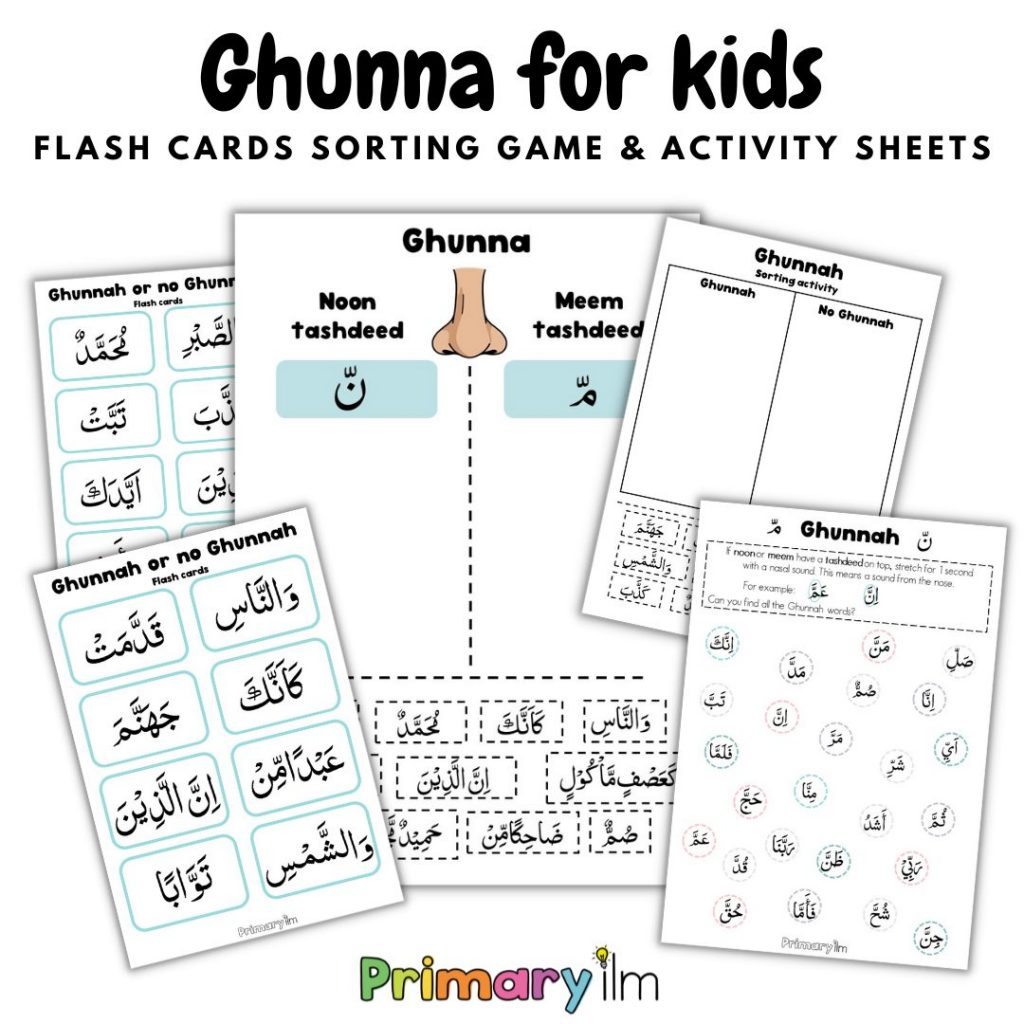
To help children recognise and practise Ghunnah, we’ve created a bunch of Ghunnah Worksheets.
The sheets includes:
- Ghunnah letters
- Simple examples
- Find the ghunnah activities
- Beginner-friendly practice
- Child-friendly layout
Join the primary ilm membership to access these sheets and 3000+ other islamic worksheets including tajweed presentations, workbooks and mini booklets.
Ghunnah quiz
Frequently Asked Questions
What is Ghunnah in Tajweed?
Ghunnah is a soft nasal sound made through the nose when reciting certain letters of the Qur’an. It is one of the fundamental rules of Tajweed.
What are the Ghunnah letters?
The main Ghunnah letters are Noon (ن) and Meem (م), especially when they carry a Shaddah.
How many counts is Ghunnah?
In most situations, Ghunnah is held for two counts.
Is Ghunnah compulsory?
Yes. Ghunnah forms part of correct Tajweed and should be observed when the relevant rules apply.
Can children learn Ghunnah?
Absolutely. By introducing one rule at a time through simple examples, listening practice and engaging worksheets, children can build confidence in their Qur’an recitation from an early age.
Final Thoughts
Learning Ghunnah is an important step in reading the Qur’an correctly.
Although it may seem like a small detail, this gentle nasal sound helps preserve the beauty and precision of Allah’s words.
Don’t feel pressured to master it immediately.
Listen carefully.
Practise consistently.
Learn with a qualified teacher whenever possible.
Over time, Ghunnah will become a natural part of your Qur’an recitation, helping you read with greater confidence and care.
Continue Your Child’s Islamic Learning Journey
Looking for more Islamic resources?
✓ Browse our growing collection of free resources by creating a free account.
✓ Join our monthly mailing list for free downloads, updates and new resources.
✓ Explore the Primary Ilm Membership for access to 3,000+ Islamic worksheets, activities, presentations and printables.
✓ Follow us on Instagram and Pinterest for ideas and inspiration.