Learning the Arabic alphabet is one thing. Learning what happens when those letters suddenly start changing shape inside a word is another.
A child might confidently recognise ب as Baa on a flashcard, then see the same letter joined inside a word and wonder where it has gone. This is completely normal. Arabic letters can look different depending on where they appear in a word, and understanding how they connect is an important step towards actually reading Arabic rather than simply recognising individual letters.
In this guide, we’ll look at how Arabic letters join, which letters do not connect to the letter after them, and some simple ways to help children practise without making it feel overwhelming.
Contents
What Does It Mean to Join Arabic Letters?
How Arabic Letters Connect
Beginning, Middle and End Forms
Which Arabic Letters Do Not Connect?
How to Join Arabic Letters Step by Step
Simple Arabic Joining Examples
Common Mistakes Beginners Make
How to Teach Connecting Arabic Letters to Kids
Connecting Arabic Letters Worksheets
Free Arabic Joining Letters Printable
What Does It Mean to Join Arabic Letters?
Arabic is written from right to left, and most Arabic letters connect to the letters beside them when they are written inside a word.
This means a letter does not always keep the exact same shape you first learnt in the alphabet.
Take the letter ب.
On its own, it looks like:
ب
But when it joins other letters, its shape can change depending on whether it is at the beginning, middle or end of the word.
That is why a child can know all 28 Arabic letters perfectly and still find reading joined words difficult. They are now learning another skill: recognising those same letters in their connected forms.
How Arabic Letters Connect
Most Arabic letters can connect to the letter before them and the letter after them.
Imagine the letters almost holding hands.
When several connecting letters appear together, they form one continuous shape rather than sitting separately like English letters usually do.
For example, instead of seeing individual letters spaced apart, children gradually learn to recognise them as part of a joined word.
This is an important stage because Arabic reading depends on children being able to look beyond the overall shape of the word and identify the individual letters hiding inside it.
At first, it can help to physically separate a word into its letters and then put it back together again.
For example:
ب + ي + ت
then show:
بيت
This helps children see that the letters have not disappeared. They have simply changed shape because they are connected.
Beginning, Middle and End Forms
Many Arabic letters have different forms depending on their position in a word.
A letter may appear:
on its own
at the beginning of a word
in the middle of a word
at the end of a word
Take Baa again:
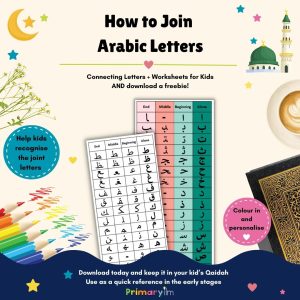
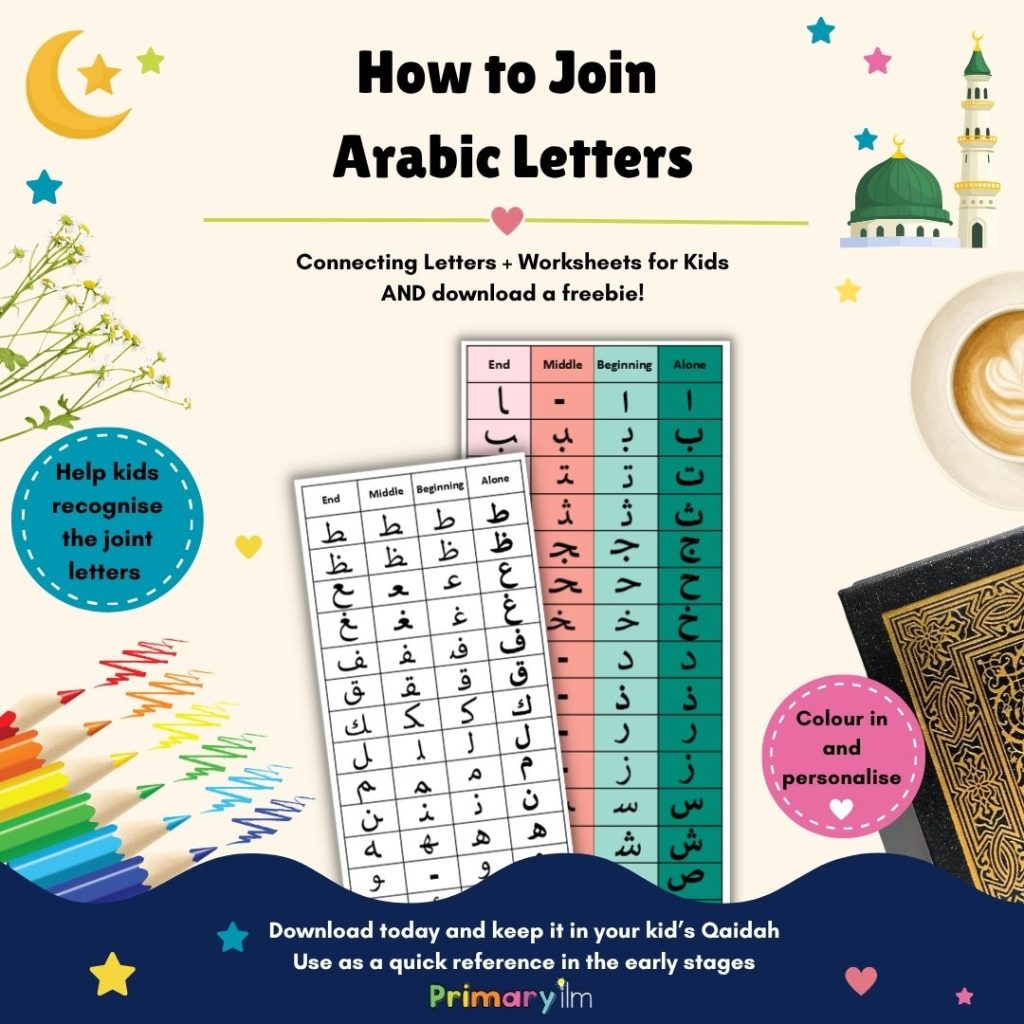
ب — isolated
بـ — beginning
ـبـ — middle
ـب — end
The letter is still Baa in every example.
The dot remains underneath, and the basic shape is still recognisable, but the joining lines change depending on where it sits.
This is one of the most useful things to show children visually. Instead of telling them that Arabic letters “change”, show them all four forms side by side and ask:
“What stayed the same?”
“What changed?”
That gets them looking carefully at the features that help us recognise each letter.
Which Arabic Letters Do Not Connect?
This is where Arabic joining becomes a little easier, because there is a small group children can simply learn to recognise.
These letters do not connect to the letter that comes after them:
ا
د
ذ
ر
ز
و
You may sometimes hear these called non-connecting letters.
They can connect to a letter before them, but they break the connection with the letter that follows.
For example, if one of these letters appears in the middle of a word, you may see a small visual gap before the next letter begins.
This can be confusing at first because children sometimes think the word has ended. It hasn’t. The letters are still part of the same word; they simply cannot join together at that point.
A simple activity is to ask children to circle these six letters whenever they spot them in a word.
Over time, they begin to recognise the pattern automatically.
How to Join Arabic Letters Step by Step
When children first practise joining Arabic letters, I would avoid starting with long words.
Use two letters first.
For example:
ب + ت
Show the letters separately, then show how they look when connected.
Once the child understands that idea, move to three-letter combinations.
The important thing is to get them thinking in a simple sequence:
Which letters are in the word?
Can these letters connect?
Where is each letter positioned?
What shape will it take?
At the beginning, children may need to work through those questions slowly. Eventually, the process becomes automatic.
Simple Arabic Joining Examples
You can begin with very familiar letters and simple combinations.
For example:
ب + ي + ت → بيت
ك + ت + ب → كتب
م + س + ج + د → مسجد
You don’t necessarily need to focus on vocabulary straight away. The goal can simply be recognising where each letter begins and ends.
You could write a joined word and ask:
“How many letters can you find?”
Then ask the child to write those letters separately underneath.
This works really well because children practise both recognising connected letters and breaking words apart.
Common Mistakes Beginners Make
One common difficulty is expecting Arabic letters to look exactly the same inside a word as they do on an alphabet poster. If children only ever practise isolated letters, joined writing can feel almost like learning an entirely new alphabet.
Another mistake is trying to memorise every beginning, middle and end form separately. Children do need repeated exposure, but it is usually more helpful to practise letters inside real combinations rather than memorising dozens of shapes with no context.
Non-connecting letters also cause confusion. A child may see a gap after ا or ر and assume they are looking at two separate words. Showing lots of examples helps them learn that a gap does not always mean the word has finished.
And finally, don’t rush from recognising letters straight into full words. There is a useful middle stage where children simply practise joining two and three letters together.
How to Teach Connecting Arabic Letters to Kids
Keep the practice visual and hands-on.
Start with a letter the child already knows well and show how it changes in different positions. Then compare that letter with another one.
You could use letter cards and physically move them together, or write separate letters on a whiteboard and ask your child to predict what they will look like when joined.
Sorting activities work well too. Children can sort letters into:
connects on both sides
does not connect to the next letter
You can also turn it into a quick spotting game:
“Can you find the non-connecting letter?”
“Which letter is in the middle?”
“Can you separate this word into three letters?”
Short, repeated practice tends to work far better than giving children a full page of joined Arabic and expecting them to work everything out at once.
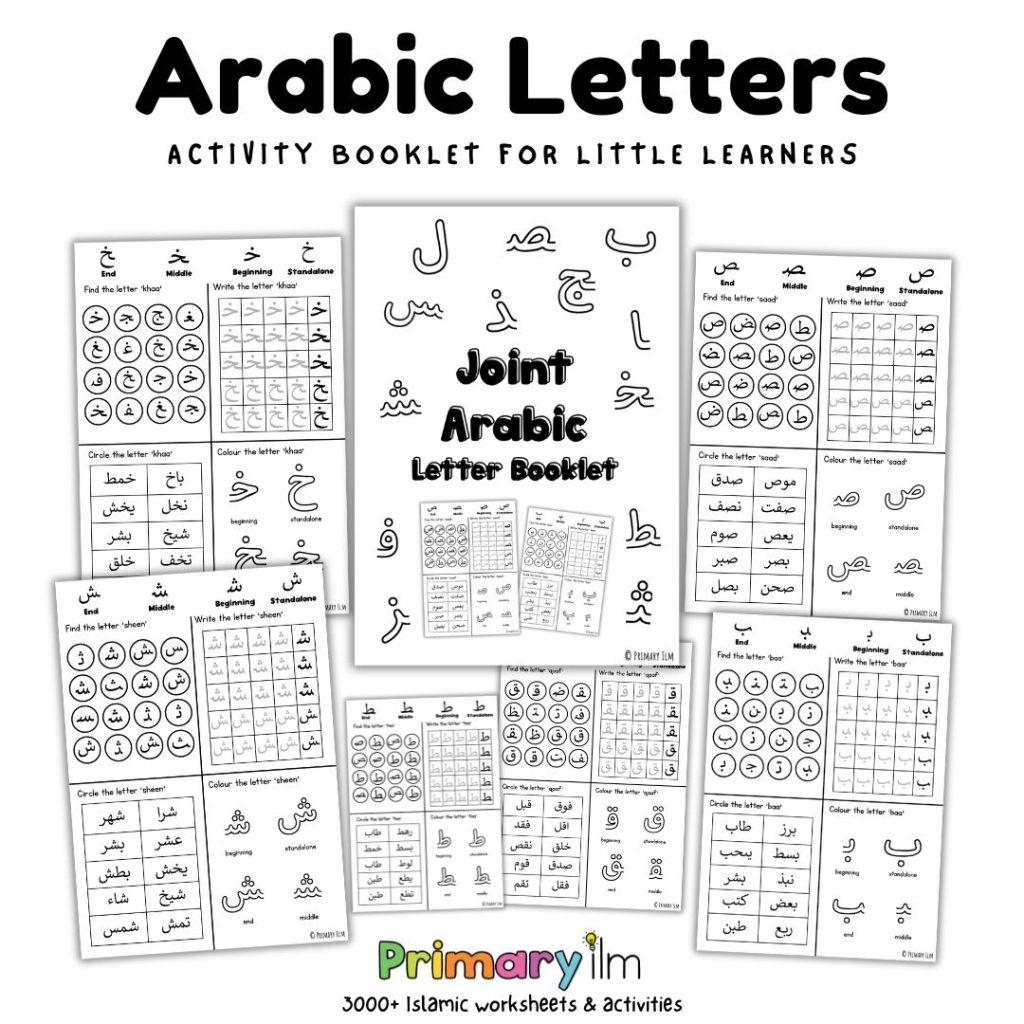
Connecting Arabic Letters Worksheets

Worksheets are particularly useful for this stage because children need lots of repeated practice seeing the same letters in different positions.
A good connecting Arabic letters worksheet might ask children to:
match isolated letters to their connected forms
join two letters together
separate a joined word into individual letters
identify beginning, middle and end forms
circle non-connecting letters
trace joined Arabic words
complete missing connected letters
At Primary Ilm, our Arabic resources are designed to help children move gradually from recognising individual letters towards reading connected Arabic with more confidence.
The key is giving them enough practice for those different letter shapes to stop looking unfamiliar.
Free Arabic Joining Letters Printable
To make this easier, you can also create a simple Arabic connecting letters chart showing each letter in its:
isolated form
beginning form
middle form
end form
That gives children something they can keep beside them while completing worksheets or practising Arabic reading.
[Download the free Arabic joining letters printable here.]
Frequently Asked Questions
How do Arabic letters connect?
Most Arabic letters connect to the letters beside them. Their shape can change depending on whether they appear at the beginning, middle or end of a word.
Which Arabic letters do not connect?
The main letters that do not connect to the letter after them are:
ا د ذ ر ز و
Why do Arabic letters change shape?
Arabic is a joined script, so letters adapt slightly depending on their position and which letters appear beside them. The letter itself remains the same even though its written form changes.
How can children practise joining Arabic letters?
Start with two-letter combinations before moving on to longer words. Matching, tracing, sorting and separating joined words into individual letters can all help.
Are connecting Arabic letters difficult for beginners?
They can feel difficult at first, especially when children have only learnt letters in their isolated form. With regular exposure to beginning, middle and end forms, children usually start recognising them much more easily.
Final Thoughts
Learning to join Arabic letters is one of those stages where children can suddenly feel as though everything they learnt about the alphabet has changed.
It hasn’t.
The same letters are still there. They are simply adapting their shape to fit together.
Once children begin recognising those patterns, Arabic words stop looking like one complicated shape and start becoming individual letters they can identify, separate and eventually read.
So take it slowly.
Start with two letters.
Practise the same shapes again and again.
And let confidence build from there.
Continue Your Child’s Islamic Learning Journey
Looking for more Islamic resources?
✓ Browse our growing collection of free resources by creating a free account.
✓ Join our monthly mailing list for free downloads, updates and new resources.
✓ Explore the Primary Ilm Membership for access to 4,000+ Islamic worksheets, activities, presentations and printables.
✓ Follow us on Instagram and Pinterest for ideas and inspiration.