“Be patient.”
It’s probably something most of us say to our children quite regularly.
Wait for your turn.
Give me a minute.
Keep trying.
You can’t have that right now.
But sabr in Islam is much deeper than simply waiting quietly.
Sabr is about how we respond when something is difficult, frustrating or doesn’t go the way we hoped. It is continuing to do what is right, controlling our reactions and remembering Allah through moments we would rather avoid.
And children don’t need to wait until they experience a huge hardship to begin learning it.
The ordinary frustrations of childhood give us opportunities to teach sabr every single day.
Contents
What Is Sabr in Islam?
What Does Sabr Mean for Children?
Sabr Is More Than Just Waiting
Why Children Need to Learn Sabr
Teach Sabr During Small Everyday Moments
When They Have to Wait
When Something Feels Difficult
When They Don’t Get What They Want
When They Feel Angry or Frustrated
When Plans Change
Connect Sabr Back to Allah
Use Stories of the Prophets to Teach Sabr
Model Sabr Instead of Just Asking for It
Simple Sabr Activities for Children (free printable)
What to Say Instead of “Just Be Patient”
Frequently Asked Questions
What Is Sabr in Islam?
Sabr (صبر) is often translated as patience, but its meaning is much broader.
Sabr can mean remaining steady when something is difficult, continuing to obey Allah, staying away from what is wrong and responding to hardship in a way that pleases Him.
Allah says:
“Seek help through patience and prayer. Indeed, Allah is with the patient.”
Surah Al-Baqarah, 2:153
This gives children an important message from the beginning:
Being patient doesn’t mean we are dealing with difficulties alone.
Allah is with those who have sabr.
What Does Sabr Mean for Children?
For a young child, we don’t need to begin with a complicated definition.
We can explain sabr as:
“Sabr means trying to do the right thing even when something feels difficult.”
That might look like:
Waiting without grabbing.
Trying again when their writing is difficult.
Staying calm when they lose a game.
Accepting that the answer is no.
Finishing something even when they would rather stop.
Speaking kindly even when they are annoyed.
Children understand Islamic concepts much better when they can connect them to situations they actually experience.
Sabr Is More Than Just Waiting
When we tell children to “have sabr”, they can easily begin to think sabr simply means waiting.
But waiting is only one part of it.
Sabr can also mean persevering.
A child struggling to read a new word needs sabr.
A child practising a Surah they keep forgetting needs sabr.
A child trying not to shout when they are angry needs sabr.
A child accepting disappointment needs sabr.
A child continuing to make dua even when they haven’t received what they asked for needs sabr.
Teaching children this broader understanding makes sabr something they can recognise throughout their lives.
Why Children Need to Learn Sabr
Children naturally want things quickly.
They want the toy now.
They want their turn now.
They want to be good at something immediately.
They want the answer they hoped for.
And when that doesn’t happen, the emotions can be big.
Rather than viewing these moments only as behaviour that needs correcting, we can sometimes view them as opportunities to build an Islamic quality.
The aim isn’t to stop children from feeling frustrated, disappointed or upset.
Those feelings are normal.
The lesson is what they learn to do with those feelings.
Teach Sabr During Small Everyday Moments
We sometimes imagine that lessons about sabr need to begin with stories of enormous trials.
Those stories are important, but children can first learn sabr through much smaller experiences.
The queue at the shop.
Their sibling getting the first turn.
A tower falling down.
Waiting for dinner.
Finding schoolwork difficult.
Not winning.
Plans changing.
Being told they can’t have something.
These tiny moments happen constantly.
And each one gives us an opportunity to put a name to what the child is practising:
“That was difficult, but you kept trying. That is sabr.”
Over time, sabr stops being an abstract Islamic Studies word and becomes something children recognise in themselves.
When They Have to Wait
Waiting is one of the easiest places to introduce sabr.
Instead of only saying:
“Be patient.”
Try explaining what they are doing.
“You really want your turn now. Waiting is difficult, but you’re practising sabr.”
For younger children, the waits should still be realistic for their age. Teaching sabr doesn’t mean deliberately making children wait unnecessarily.
It simply means using the waiting that naturally happens in everyday life as a learning opportunity.
When Something Feels Difficult
One of the most valuable forms of sabr children can learn is not giving up immediately when something is hard.
Perhaps they’re learning to read Arabic.
They can’t remember the next ayah.
Their maths question feels impossible.
Their drawing doesn’t look how they wanted.
Our instinct can be to rush in and fix the problem.
Sometimes, instead, we can encourage them:
“It’s hard because you’re still learning. Let’s try once more.”
Then connect it back to their Islamic learning:
“Keeping going when something is difficult is also a type of sabr.”
That makes sabr active rather than passive.
When They Don’t Get What They Want
This is probably one of the hardest lessons for children.
Sometimes the answer is no.
Sometimes somebody else wins.
Sometimes their friend gets something they wanted.
Sometimes a plan they were excited about doesn’t happen.
Children are allowed to feel disappointed.
Teaching sabr doesn’t mean telling them:
“You shouldn’t be upset.”
Instead, we can acknowledge the feeling while helping them manage their response.
“I know you really wanted that. It’s okay to feel disappointed. We can still choose how we respond.”
This is where sabr becomes something meaningful.
When They Feel Angry or Frustrated
Sabr is especially important when emotions are strong.
A child may know perfectly well that shouting, hitting or saying something hurtful is wrong, but remembering that lesson while angry is much harder.
Those moments require practice.
When the child is calm again, talk about what happened.
“What could we try next time when you feel that angry?”
Perhaps they could:
Take a moment away.
Ask an adult for help.
Take some slow breaths.
Make wudu.
Use words to explain what is wrong.
The goal is to gradually give children ways to manage difficult feelings rather than simply telling them to stop having them.
When Plans Change
Children often struggle when something they expected suddenly changes.
The trip gets cancelled.
Someone can’t come.
The weather changes the plan.
Something they were looking forward to is postponed.
These moments can be wonderful opportunities to gently introduce both sabr and trust in Allah.
You might say:
“We planned something different, but Allah knew this would happen. We can feel disappointed and still have sabr.”
Children begin to learn that faith does not mean they will always get the outcome they wanted.
It gives them something to hold onto when they don’t.
Connect Sabr Back to Allah
This part matters.
If we only teach children to wait, persevere and control their emotions, we may be teaching patience, but we haven’t necessarily taught Islamic sabr.
Bring Allah into the conversation.
Remind children that Allah sees when something is difficult.
Allah knows when they are trying.
Allah rewards patience.
Allah can help them through difficult moments.
Allah tells us that He is with those who are patient.
That turns sabr from a simple behaviour-management tool into an act of worship.
Use Stories of the Prophets to Teach Sabr
The stories of the Prophets give children powerful examples of sabr.
Prophet Ayyub عليه السلام remained patient through tremendous hardship.
Prophet Yusuf عليه السلام faced separation from his family, injustice and imprisonment, yet continued to remain faithful to Allah.
Prophet Ya’qub عليه السلام demonstrated patience during the long separation from his son Yusuf.
And our Prophet Muhammad ﷺ showed remarkable patience through rejection, hardship and opposition.
You don’t necessarily need to tell the whole story each time.
Once children know these stories, you can refer back to them during everyday situations:
“Remember what we learnt about Prophet Ayyub? He kept turning to Allah even when things were very difficult.”
This helps children connect the stories of the Prophets to their own lives rather than seeing them simply as stories from the past.
Model Sabr Instead of Just Asking for It
Children learn a lot about patience from watching us.
And unfortunately, they often get to watch us practise it in very real situations.
Traffic.
A slow queue.
Something breaking.
Being interrupted for the tenth time.
Plans changing.
Technology refusing to work when we’re already late.
We won’t respond perfectly every time.
But children hearing us say:
“I’m getting frustrated, so I need to calm down.”
or:
“This isn’t what I wanted, but insha’Allah we’ll work something else out.”
can teach them far more than another reminder to “be patient”.
They see that sabr is something adults need to practise too.
Simple Sabr Activities for Children (free printable)
You don’t need complicated activities to reinforce the lesson.
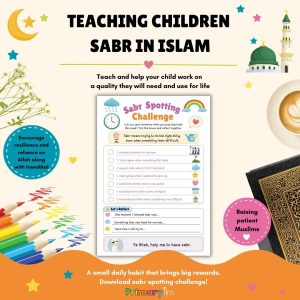
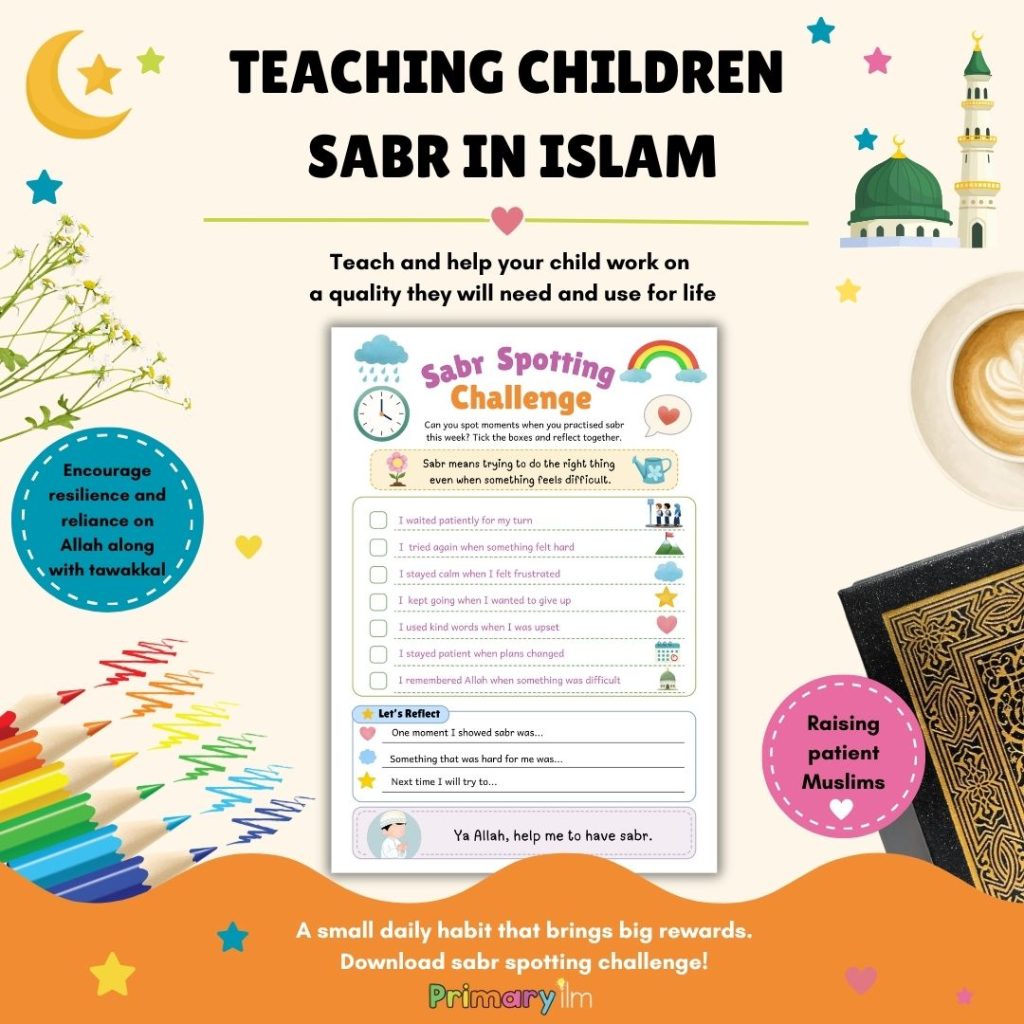
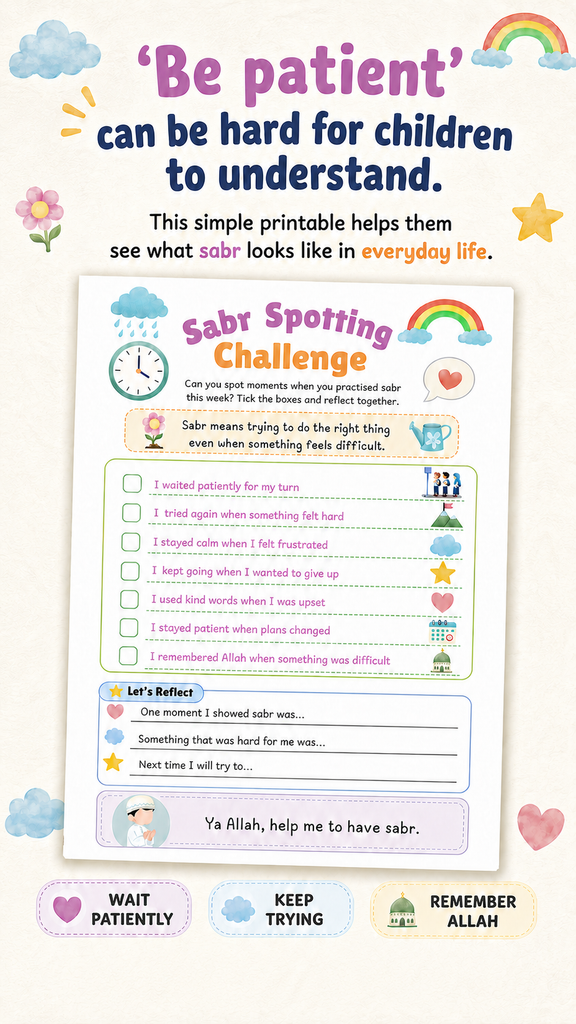
Try creating a Sabr Spotting Challenge.
Ask your child to notice three moments during the day when they needed sabr.
For example:
“I waited for my turn.”
“I tried my reading again.”
“I stayed calm when my brother took my toy.”
Older children could keep a simple sabr journal and answer:
What happened?
How did I feel?
What did I do?
What could I do next time?
You could also discuss different scenarios and ask:
“What would sabr look like here?”
This helps children understand that patience can look different depending on the situation.
What to Say Instead of “Just Be Patient”
“Be patient” isn’t wrong.
But sometimes children need a little more help understanding what patience actually looks like.
Instead, try:
“Waiting is hard. What can we do while we wait?”
“You’re frustrated, but you can still choose what you do next.”
“Let’s try one more time.”
“You don’t have to like what happened, but we can practise sabr with how we respond.”
“Allah knows this is difficult for you.”
“You really wanted that. It’s okay to feel disappointed.”
“What would sabr look like right now?”
These phrases give children something practical to work with.
Frequently Asked Questions
What does sabr mean in Islam?
Sabr is commonly translated as patience, but it also includes perseverance, self-control and remaining steadfast in doing what pleases Allah during difficult situations.
How can I explain sabr to a child?
A simple explanation is:
“Sabr means trying to do the right thing even when something feels difficult.”
Then use examples from situations your child experiences regularly.
How can children practise sabr?
Children can practise sabr by waiting for their turn, continuing when something is difficult, managing frustration, accepting disappointment and trying to respond kindly when they feel upset.
Does sabr mean children shouldn’t be upset?
No.
Sabr doesn’t mean children aren’t allowed to feel angry, sad or disappointed.
It means learning how to respond to those feelings in a better way while continuing to turn to Allah.
What does the Qur’an say about sabr?
Allah repeatedly praises those who are patient. In Surah Al-Baqarah, Allah tells believers to seek help through patience and prayer and reminds us that Allah is with those who are patient (2:153).
Final Thoughts
We don’t teach children sabr only by sitting them down for a lesson about patience.
We teach it when their sibling gets the first turn.
When the Lego tower collapses.
When they can’t remember the ayah they’ve practised all week.
When they desperately want something and the answer is no.
When plans change.
When learning feels difficult.
These moments may seem small to us, but they are big to a child.
And every one of them is an opportunity to gently teach:
Things will not always go the way we want.
Difficult feelings are part of life.
We can choose how we respond.
And through it all, we can turn back to Allah.
That is where sabr begins.
Continue Your Child’s Islamic Learning Journey
Looking for more Islamic resources?
✓ Browse our growing collection of free resources by creating a free account.
✓ Join our monthly mailing list for free downloads, updates and new resources.
✓ Explore the Primary Ilm Membership for access to 3,000+ Islamic worksheets, activities, presentations and printables.
✓ Follow us on Instagram and Pinterest for ideas and inspiration.