The first few weeks of memorising Juz Amma are usually the easy part. Your child learns An-Nas, then Al-Falaq, then Al-Ikhlas, and it feels like things are moving fast. It’s a few months in that it gets harder to keep track; which Surahs are solid, which ones need more work, and which haven’t been started yet.
That’s really what a Juz Amma tracker is for. A simple checklist lets your child see their own progress, and it lets you (or their teacher) spot at a glance where the gaps are.
Below you’ll find the full Juz Amma Surah list in order, a straightforward memorisation routine, and a free printable tracker you can use at home, in madrassah, or in an Islamic school.
Contents
- What Is Juz Amma?
- Juz Amma Surah List in Order
- Free Juz Amma Tracker for Kids
- How to Use a Juz Amma Tracker
- A Simple Memorisation Routine
- Helping Children Retain What They’ve Memorised
- How Long Does Juz Amma Take to Memorise?
- What to Do Once a Surah Is Memorised
- FAQs
What Is Juz Amma?
Juz Amma is the 30th and final section of the Qur’an, and one of the 30 Ajza’ the Qur’an is traditionally divided into to make reading and memorisation more manageable. It runs from Surah An-Naba (78) to Surah An-Nas (114), 37 Surahs in total.
Because so many of them are short, Juz Amma is where most children (and adult beginners) start. The usual first few are Al-Fatihah, An-Nas, Al-Falaq, Al-Ikhlas, Al-Kawthar and Al-Asr, before moving on to the longer ones as confidence builds.
Juz Amma Surah List in Order
| No. | Surah | Simple English meaning |
|---|---|---|
| 78 | An-Naba | The News |
| 79 | An-Nazi’at | Those Who Pull Out |
| 80 | Abasa | He Frowned |
| 81 | At-Takwir | The Folding Up |
| 82 | Al-Infitar | The Cleaving |
| 83 | Al-Mutaffifin | Those Who Give Less |
| 84 | Al-Inshiqaq | The Splitting Open |
| 85 | Al-Buruj | The Constellations |
| 86 | At-Tariq | The Nightcomer |
| 87 | Al-A’la | The Most High |
| 88 | Al-Ghashiyah | The Overwhelming |
| 89 | Al-Fajr | The Dawn |
| 90 | Al-Balad | The City |
| 91 | Ash-Shams | The Sun |
| 92 | Al-Layl | The Night |
| 93 | Ad-Duha | The Morning Brightness |
| 94 | Ash-Sharh | The Relief |
| 95 | At-Tin | The Fig |
| 96 | Al-Alaq | The Clinging Form |
| 97 | Al-Qadr | The Decree |
| 98 | Al-Bayyinah | The Clear Proof |
| 99 | Az-Zalzalah | The Earthquake |
| 100 | Al-Adiyat | The Chargers |
| 101 | Al-Qari’ah | The Striking Calamity |
| 102 | At-Takathur | Competition for More |
| 103 | Al-Asr | Time |
| 104 | Al-Humazah | The Slanderer |
| 105 | Al-Fil | The Elephant |
| 106 | Quraysh | Quraysh |
| 107 | Al-Ma’un | Small Kindnesses |
| 108 | Al-Kawthar | Abundance |
| 109 | Al-Kafirun | The Disbelievers |
| 110 | An-Nasr | The Help |
| 111 | Al-Masad | The Palm Fibre |
| 112 | Al-Ikhlas | Sincerity |
| 113 | Al-Falaq | Daybreak |
| 114 | An-Nas | Mankind |
(English meanings vary a little between translations — this is a simplified version.)
Free Juz Amma Tracker for Kids
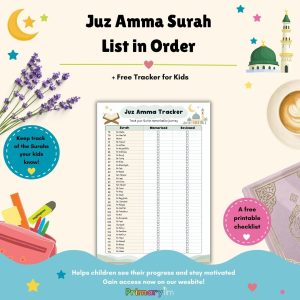
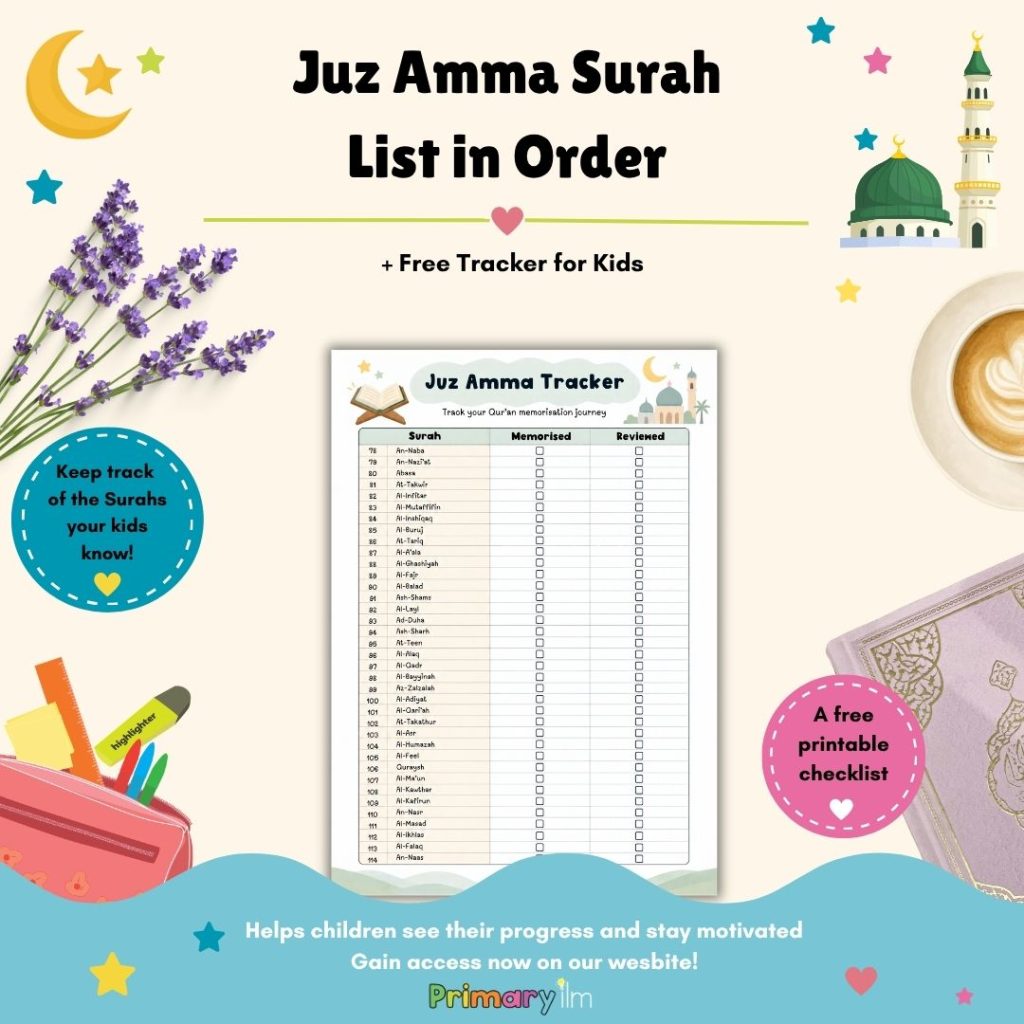
We’ve put together a free tracker covering all 37 Surahs, so children have something concrete to mark off as they go. Whether that’s during home practice, madrassah, an Islamic school timetable, or a Juz Amma challenge you’re running with a group.
It’s not meant to turn memorisation into a race. It’s just a way for a child to see, in black and white, how far they’ve actually come.
[Download the free Juz Amma tracker PDF here.]
How to Use a Juz Amma Tracker
The simplest approach is one tick per Surah once it’s memorised. But I’d actually push back on that a little. I prefer separating learning from secure memorisation, with maybe two columns: Memorised, Review.
Here’s why: a child can recite a Surah perfectly today and stumble over it in three weeks. That’s completely normal, not a sign anything’s gone wrong. So the tracker shouldn’t just answer “have we memorised this?” It should also help you notice when something hasn’t been revisited in a while.
For younger kids, colouring in a star or box each time a Surah feels secure works well. Older children might prefer a more detailed Hifz log.

A Simple Memorisation Routine
You don’t need anything elaborate here consistency does most of the work.
Listen first. Let your child hear the ayah recited correctly, several times over. Sticking with the same reciter helps them get used to the rhythm and pronunciation.
Take small bites. Don’t aim for a whole Surah in one sitting. For the longer ones, one or two ayat is plenty for a single session.
Repeat, then test. Go over the new ayah a few times while looking at the Qur’an, then try it without looking.
Connect it. Once the new section is solid, link it back to what came just before.
Revise before adding anything new. This is the step everyone skips when they’re short on time but it matters most. Before starting something new, have your child recite something they’ve already learned.
Helping Children Retain What They’ve Memorised
Memorising a Surah once doesn’t mean it’s memorised for good. Revision is part of the process, not an extra thing you tack on.
A simple structure that works well: in each session, cover a new Surah, a recent one, and an older one. So a session might look like two new ayat, a revisit of last week’s Surah, and one older Surah your child hasn’t recited in a while.
That way nothing quietly falls off the back of the list as new material gets added. Salah is also a natural chance to revise. Once your child knows a few short Surahs, encourage them to rotate through them in prayer rather than reaching for the same one every time.
Don’t Race Through the Tracker
Worth flagging, because trackers can sometimes backfire. A child looks at a page full of empty boxes and the goal becomes “finish them all” rather than actually knowing the Surahs well.
A child who’s confident in ten Surahs and revises them regularly is usually in a stronger position than one who’s rushed through twenty-five and forgotten half. So it’s worth praising things like consistent revision, careful pronunciation, good Tajweed, trying again after a mistake, and understanding what they’re reciting not just how many boxes are ticked.
The tracker is there to support the learning.
How Long Does Juz Amma Take to Memorise?
There’s no fixed answer really as it depends on the child’s age, how comfortable they are reading Arabic, what they already know, how often they practise, and how much time goes into revision versus new material.
Some children move through Juz Amma quickly. Others take a few years. Neither is better (although being able to retain large amounts of text in a short timeframe is impressive), the more useful question isn’t “how fast can we finish?” but “is what we’ve learned actually sticking?” Regular, manageable practice tends to hold up far better than occasional bursts of intensive memorisation.
What to Do Once a Surah Is Memorised
This is where it’s worth going a step further than memorisation. Once a Surah is learned, spend some time on what it actually means: What is this Surah about? What does it tell us about Allah? Is there a lesson or story in it? Is there one ayah worth sitting with a bit longer?
Primary Ilm has a growing set of Tafseer booklets and Surah activities built for exactly this, helping children understand the short Surahs they’re memorising, rather than just reciting them well without knowing what they’re saying (which happens more often than you’d think).
The goal is both “I know this Surah” and, eventually, “I understand what it’s teaching me.”

Frequently Asked Questions
How many Surahs are in Juz Amma?
37, from Surah An-Naba to Surah An-Nas.
What number Juz is Juz Amma?
Juz 30: the final section of the Qur’an.
What is the first Surah in Juz Amma?
Surah An-Naba (Surah 78).
What is the last Surah in Juz Amma?
Surah An-Nas (Surah 114).
Why is it called Juz Amma?
It takes its name from the opening words of Surah An-Naba: “Amma yatasa’alun…”
Where should children start memorising Juz Amma?
Most start with the shortest Surahs near the end: An-Nas, Al-Falaq, Al-Ikhlas — before working towards the longer ones. There’s no rule that says you have to go in order from Surah 78 onward.
What is a Juz Amma tracker?
A checklist for recording which Surahs a child is learning, has memorised, or needs to revise.
Final Thoughts
There’s something genuinely nice about watching a Juz Amma tracker fill up, Surah by Surah. But the ticks aren’t really the point. What matters is a child slowly building a relationship with the Qur’an; learning it, coming back to it when they forget, understanding what it means, and eventually carrying it into their own Salah and their adult life.
Use the tracker. Celebrate the small wins. But don’t get too caught up in how fast the boxes fill. Steady, consistent practice will insha’allah outlast a rush to the finish.
Continue Your Child’s Islamic Learning Journey
Looking for more Islamic resources?
✓ Browse our growing collection of free resources by creating a free account.
✓ Join our monthly mailing list for free downloads, updates and new resources.
✓ Explore the Primary Ilm Membership for access to 3,000+ Islamic worksheets, activities, presentations and printables.
✓ Follow us on Instagram and Pinterest for ideas and inspiration.