


In a world where children are constantly exposed to new toys, gadgets and things to want, teaching gratitude can sometimes feel like an uphill battle.
Many of us want our children to say Alhamdulillah sincerely, appreciate what they have, and recognise the countless blessings Allah has given them. But gratitude isn’t something children automatically develop. Like kindness, patience and generosity, it needs to be nurtured over time.
The encouraging thing is that teaching gratitude in Islam doesn’t require long lectures or complicated lessons. Some of the most meaningful lessons happen during everyday moments; around the dinner table, during a walk to the park, or in conversations before bed.
By helping our children notice Allah’s blessings and regularly thank Him for them, we can raise children who are content, appreciative and connected to their Creator.
What You’ll Learn in This Article
What Is Gratitude in Islam?
Why Is Gratitude Important for Children?
Make Alhamdulillah Part of Everyday Life
Help Children Notice Allah’s Blessings
Create a Daily Gratitude Routine
Let Your Children See Your Gratitude
Encourage Children to Thank People
Use Disappointments as Teaching Moments
Start a Gratitude Journal
Free Gratitude Journal Printable
The Story of Prophet Sulaiman (AS) and Gratitude
Frequently Asked Questions
Final Thoughts
What Does Islam Teach About Gratitude?
Gratitude, or shukr, is a central part of our faith.
Allah says in the Qur’an:
“If you are grateful, I will surely increase you [in favour].”
(Surah Ibrahim 14:7)
When we teach our children gratitude, we’re teaching them far more than good manners.
We’re helping them understand that every blessing ultimately comes from Allah.
The warm meal on their plate.
The roof over their head.
The people who love them.
Their ability to see, hear, learn and play.
When children begin to recognise where these blessings come from, gratitude becomes something much deeper than simply saying “thank you.”
Why Is Gratitude Important for Children?
Grateful children often grow into grateful adults.
Children who regularly reflect on their blessings are more likely to be content with what they have, less focused on constantly wanting more, and more aware of the needs of others.
Most importantly, gratitude helps strengthen their relationship with Allah. It encourages them to see His kindness in their everyday lives and reminds them that He is the source of every blessing they enjoy.
1. Make saying Alhamdulillah Part of Everyday Life
Children learn by listening.
When they hear Alhamdulillah throughout the day, they naturally begin to use it themselves.
Try saying it when:
- You finish a meal
- You arrive somewhere safely
- Someone recovers from illness
- Something goes well
- You enjoy a happy family moment
Over time, children begin to associate gratitude with everyday experiences rather than only special occasions.
2. Help Children Notice Allah’s Blessings
One of the challenges with gratitude is that we often overlook blessings because they feel ordinary.
Children can be the same.
Take time to point out the blessings they might otherwise miss.
You could ask questions such as:
- Who gave us the rain?
- Who made the trees grow?
- Who gave us our eyes so we can see?
- Who gave us our family?
These simple conversations help children connect everyday experiences back to Allah and develop a habit of recognising His blessings.
3. Create a Daily Gratitude Routine
Small daily habits often have a greater impact than occasional big lessons.
Choose a time that works for your family and make gratitude part of your routine.
At dinner, during bedtime, or on the school run, ask questions like:
- What made you smile today?
- What blessing are you thankful for today?
- What is one thing you can say Alhamdulillah for?
Some days the answers will be simple. Other days they may surprise you.
What matters is helping children regularly pause and reflect.
4. Let Your Children See Your Gratitude
Children pay attention to far more than we realise.
They notice how we react when things go wrong. They hear the words we use when we’re frustrated. They observe whether we focus on what’s missing or on what we’ve been given.
If our children regularly hear us thanking Allah, they learn that gratitude is a natural part of everyday life.
Sometimes the most powerful lesson is simply hearing a parent say:
“Alhamdulillah, Allah has been so kind to us.”
5. Encourage Children to Thank People
Islam teaches us to be grateful not only to Allah but also to the people around us.
The Prophet ﷺ encouraged us to show appreciation to others.
Help your children develop this habit by encouraging them to thank:
- Their teachers
- Grandparents
- Friends
- Siblings
- Parents
- Anyone who helps them
When children learn to appreciate the people around them, they begin to develop a deeper understanding of gratitude as a whole.
6. Use Disappointments as Teaching Moments
It’s easy to feel grateful when everything goes our way.
The real challenge comes when things don’t.
Perhaps a toy breaks.
A trip gets cancelled.
They don’t get the gift they hoped for.
While it’s important to acknowledge their feelings, these moments can also become opportunities to gently remind them of the many blessings they still have.
Teaching gratitude during difficult moments helps children develop resilience and a balanced perspective on life.
7. One simple but powerful way to encourage gratitude is through journaling.
A gratitude journal gives children a dedicated space to reflect on Allah’s blessings and think about the good things in their day.
It doesn’t need to take long.
Even writing down one blessing each day can help children build a habit of reflection and appreciation.
Over time, these small moments of gratitude can have a lasting impact on the way they view the world around them.
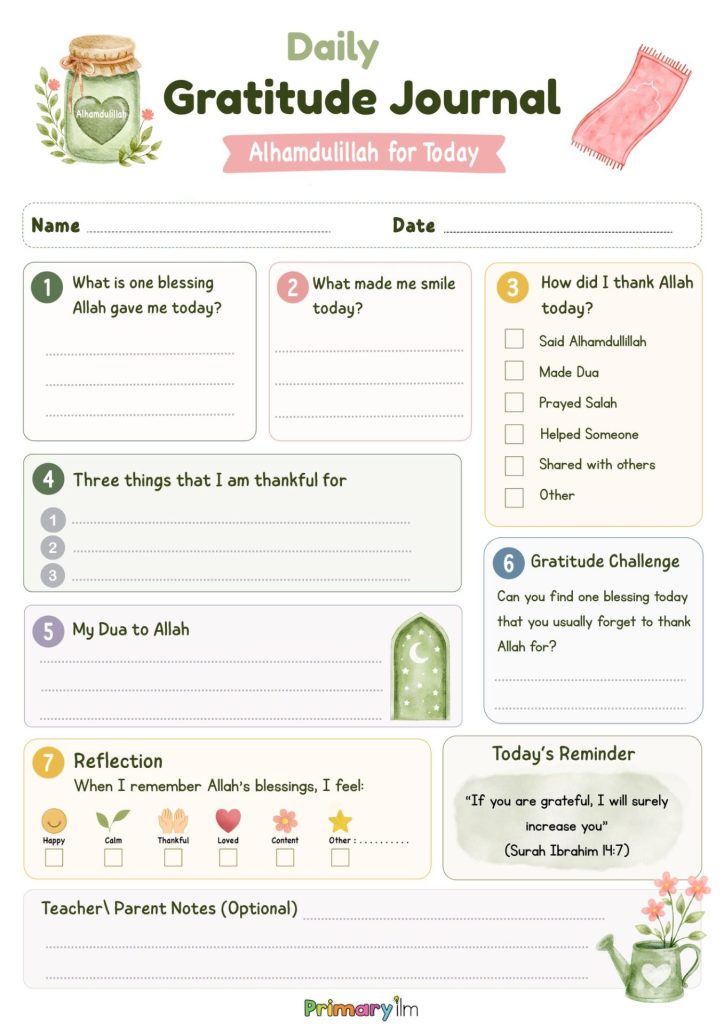
Free Gratitude Journal Printable
To help your child develop the habit of gratitude, we’ve created a free Daily Gratitude Journal Printable.
Inside, children can:
- Reflect on their blessings
- Thank Allah each day
- Record happy moments
- Make dua
- Build a stronger connection with their Creator
Download your free printable below and begin nurturing your child’s sense of gratitude.
The Story of Prophet Sulaiman (AS) and Gratitude in Islam
One of the best examples of gratitude is found in the life of Prophet Sulaiman (AS).
Allah blessed Prophet Sulaiman (AS) with many things that no one else had been given. He was a king, he had great wealth, and Allah even gave him the ability to understand the language of animals.
One day, while travelling with his army, he heard an ant warning the other ants to return to their homes so they would not be accidentally harmed.
When Prophet Sulaiman (AS) heard the ant’s words, he smiled and immediately turned to Allah in gratitude. He made the beautiful dua:
“My Lord, enable me to be grateful for Your favour which You have bestowed upon me and upon my parents, and to do righteousness of which You approve.”
(Surah An-Naml 27:19)
What’s remarkable is that Prophet Sulaiman (AS) didn’t simply enjoy his blessings. He recognised where they came from and thanked Allah for them.
This is a wonderful lesson for our children. Whether Allah blesses us with a loving family, a comfortable home, good health or even something as simple as a sunny day, we can follow the example of Prophet Sulaiman (AS) by saying Alhamdulillah and remembering the One who gave us those blessings.
Frequently Asked Questions
What does gratitude mean in Islam?
Gratitude (shukr) means recognising Allah’s blessings, appreciating them and thanking Him through our words, actions and attitude.
How can I teach my child to be grateful?
Children learn gratitude best through daily habits. Model gratitude yourself, regularly say Alhamdulillah, talk about Allah’s blessings and encourage reflection on the good things in their day.
Why is gratitude important in Islam?
Gratitude strengthens our relationship with Allah, increases our appreciation of His blessings and helps us develop contentment.
What activities help teach gratitude to children?
Gratitude journals, family reflection time, nature walks, blessing hunts, gratitude jars and daily Alhamdulillah conversations are all wonderful ways to encourage gratitude.
Final Thoughts
Teaching gratitude isn’t about raising children who simply remember to say “thank you.”
It’s about helping them develop hearts that recognise Allah’s blessings wherever they look.
When gratitude becomes part of everyday life, children begin to see the world differently. They notice the good more often. They become more content with what they have. And they learn to turn back to Allah with appreciation, not just when life is easy, but in every situation.
Every sincere Alhamdulillah is a reminder that Allah has given us far more than we could ever count and that’s a lesson worth passing on to our children.
Continue Your Child’s Islamic Learning Journey
Looking for more Islamic resources?
✓ Browse our growing collection of free resources by creating a free account.
✓ Join our monthly mailing list for free downloads, updates and new resources.
✓ Explore the Primary Ilm Membership for access to 3,000+ Islamic worksheets, activities, presentations and printables.
✓ Follow us on Instagram and Pinterest for ideas and inspiration.



3 responses
Alhamdulillah that i came to read this Beautiful Article..its Refreshing
Alhamdulillah, we need blogs like these. We need to read more of these. Thank you for reminding us on being grateful
I’m glad you think so! This is a reminder for myself first 🙂