When we teach children about Islam, we often focus on learning the Qur’an, making dua and praying Salah.
But Islam also places great importance on akhlaq which is our character, manners and the way we treat others.
Beautiful akhlaq is more than simply being polite. It is about living in a way that pleases Allah through kindness, honesty, patience and compassion.
In this guide, we’ll explore what akhlaq means in Islam, why it matters and some practical ways parents can help children develop beautiful Islamic character.
Contents
What Does Akhlaq Mean in Islam?
Why Is Akhlaq Important in Islam?
Akhlaq vs Adab: What’s the Difference?
How Can Parents Teach Akhlaq?
Free Printable: Akhlaq Challenge
What Does Akhlaq Mean in Islam?
The word akhlaq comes from the Arabic word khuluq, meaning character, morals or manners.
In Islam, akhlaq refers to the qualities that shape how we behave towards Allah, ourselves and other people.
Good akhlaq includes qualities such as:
- Kindness
- Honesty
- Patience
- Respect
- Forgiveness
- Generosity
- Humility
- Gratitude
These qualities are at the heart of a Muslim’s character and should be nurtured from a young age.
Why Is Akhlaq Important in Islam?
The Prophet Muhammad ﷺ was sent not only to teach people about worship but also to perfect good character.
He said:
“The best of you are those who have the best character.”
(Sahih al-Bukhari)
A child who develops good akhlaq learns to make choices that please Allah, care for others and become a positive influence in their family and community.
Akhlaq vs Adab: What’s the Difference?
These two terms are often mentioned together.
- Akhlaq refers to a person’s inner character and moral qualities.
- Adab refers to the outward manners and etiquette that reflect those qualities.
For example:
Saying JazakAllahu Khayran is good adab.
Being genuinely grateful and appreciative is good akhlaq.
Together, adab and akhlaq help children develop both beautiful manners and sincere character.
How Can Parents Teach Akhlaq?
Children learn character through everyday life.
Here are a few simple ways to encourage beautiful akhlaq at home.
Notice Good Behaviour
Praise honesty, kindness and patience whenever you see them.
Be a Role Model
Children learn more from what we do than what we say.
Connect Character to Allah
Help children understand that kindness and honesty are ways of earning Allah’s pleasure.
Practise Little and Often
Akhlaq grows through consistent daily habits, not one big lesson.
Free Printable: Akhlaq Challenge
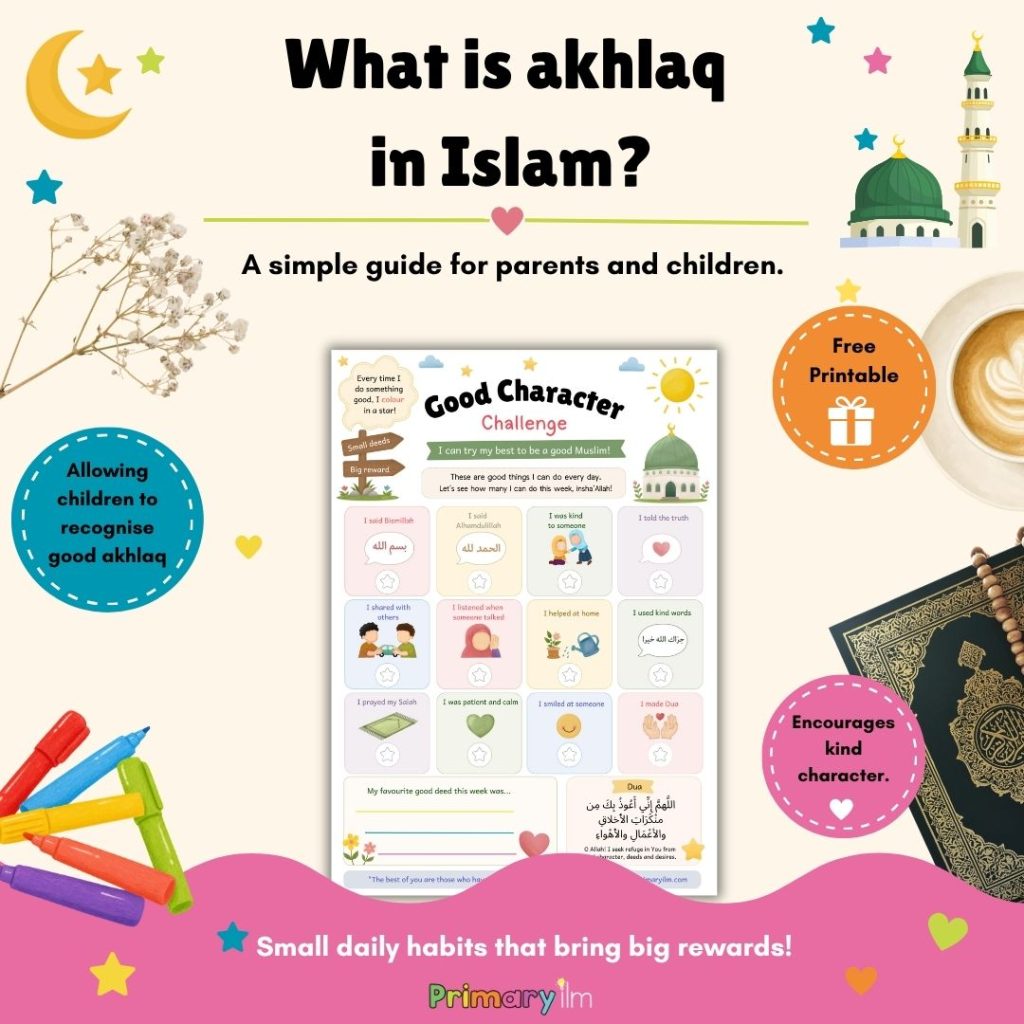
To help children put beautiful akhlaq into practice, I’ve created a free printable: Good Character Challenge.
Children can colour a star each time they:
- Say Bismillah
- Help someone
- Tell the truth
- Share with others
- Use kind words
- Pray Salah
- Show patience
It’s a simple way to encourage positive habits while helping children enjoy practising good character. You could also laminate it and stick it on the fridge. Your child can then colour it in with a whiteboard marker and have it reset every few days or after a week.

Final Thoughts
Beautiful akhlaq is one of the greatest gifts we can help our children develop.
When we encourage kindness, honesty, patience and gratitude from an early age, we’re helping them build a character that reflects the teachings of Islam and brings them closer to Allah.
Small actions, repeated every day, can shape a lifetime of beautiful character.
FAQs
What is akhlaq in Islam?
Akhlaq refers to a Muslim’s character, morals and behaviour. It includes qualities such as kindness, honesty, patience, respect and generosity.
What does akhlaq mean in Islam?
The word akhlaq comes from the Arabic word khuluq, meaning character or moral conduct.
What is the difference between adab and akhlaq?
Akhlaq refers to inner character, while adab refers to outward manners and etiquette.
How can children develop good akhlaq?
Children develop good akhlaq by observing positive role models, receiving gentle encouragement, practising good deeds daily and learning how the Prophet Muhammad ﷺ demonstrated beautiful character.
Why is akhlaq important in Islam?
Good character is highly valued in Islam. The Prophet Muhammad ﷺ taught that the best believers are those with the best character, making akhlaq an essential part of living as a Muslim.
Continue Your Child’s Islamic Learning Journey
Looking for more Islamic resources?
✓ Browse our growing collection of free resources by creating a free account.
✓ Join our monthly mailing list for free downloads, updates and new resources.
✓ Explore the Primary Ilm Membership for access to 3,000+ Islamic worksheets, activities, presentations and printables.
✓ Follow us on Instagram and Pinterest for ideas and inspiration.