Learning Tajweed can feel overwhelming when you’re first starting out.
With unfamiliar Arabic letters, colourful Mushafs and rules with names like Ikhfa, Idgham and Qalqalah, it’s easy to wonder where to begin.
The good news is that you don’t need to learn every Tajweed rule overnight.
By understanding the basic Tajweed rules one step at a time, you’ll gradually become more confident in reading the Qur’an correctly.
Whether you’re learning yourself or teaching your child, this beginner-friendly guide explains the most important Tajweed rules in a simple and easy-to-understand way.
What Is Tajweed?
Before learning the rules, it’s helpful to understand what Tajweed actually means.
The word “Tajweed” (تَجْوِيد) comes from the Arabic root “j-w-d” (ج-و-د), which means to “make something excellent” or “improve.”
In Islam, Tajweed refers to reciting the Qur’an correctly by pronouncing every letter from its proper place of articulation and giving each letter its rights.
The Prophet ﷺ recited the Qur’an beautifully, and Muslims should strive to follow his example by learning Tajweed.
Tajweed isn’t about making your voice sound impressive. It’s about preserving the words of Allah exactly as they were revealed.
Why Are Tajweed Rules Important?
Learning Tajweed helps us:
- Pronounce Arabic letters correctly.
- Avoid changing the meaning of Qur’anic words.
- Recite the Qur’an as it was revealed.
- Improve confidence when reading.
- Beautify our recitation.
Remember, learning Tajweed is a journey. Every small improvement is rewarding.
7 Basic Tajweed Rules Every Beginner Should Learn
You don’t need to memorise dozens of rules straight away.
Start with these seven foundational Tajweed rules.
1. Makharij (Points of Articulation)
Every Arabic letter has a specific place where it is pronounced.
For example:
- Some letters come from the throat.
- Others come from the tongue.
- Some come from the lips.
Learning the Makharij helps you pronounce each letter correctly and prevents similar letters from sounding the same.
2. Noon Sakinah and Tanween
This is one of the first Tajweed rules many students learn.
Depending on the letter that follows, the pronunciation changes.
There are four main rules:
- Izhar – pronounce the ن clearly.
- Idgham – merge the sound.
- Iqlab – change the sound into a م.
- Ikhfa – partially hide the sound with a light nasal tone.
Don’t worry if these names seem difficult at first, most learners study them one at a time.
3. Meem Sakinah
Just like Noon Sakinah, the letter م also has special rules.
These include:
- Izhar Shafawi
- Idgham Shafawi
- Ikhfa Shafawi
These rules teach us how to pronounce the Meem depending on the letter that follows.
4. Qalqalah
Qalqalah is sometimes called the echo or bouncing sound.
It occurs with five letters:
ق ط ب ج د
When one of these letters has a sukoon, it is pronounced with a slight bounce.
Many beginners enjoy learning this rule because it’s one of the easiest to hear.
5. Ghunnah
Ghunnah is the soft nasal sound made through the nose.
You’ll hear it most clearly with the letters:
ن and م
Learning Ghunnah helps make your recitation smoother and more accurate.
6. Madd (Stretching)
Some letters in the Qur’an are stretched when recited.
This stretching is called Madd.
Depending on the rule, a letter may be stretched for:
- Two counts
- Four counts
- Six counts
Listening carefully to experienced reciters is one of the best ways to hear Madd in practice.
7. Heavy and Light Letters
Some Arabic letters are naturally pronounced with a heavier sound, while others are read lightly.
Learning the difference improves pronunciation and helps preserve the beauty of the Qur’an.
As you continue studying Tajweed, you’ll gradually learn which letters are heavy and which are light.
How to Learn Tajweed Easily
Learning Tajweed doesn’t have to feel overwhelming.
Here are a few tips that can make the journey easier:
Learn one rule at a time.
Trying to learn everything at once often leads to frustration.
Master one rule before moving on.
Read a little every day.
Even ten minutes of daily practice is better than one long session each week.
Listen to skilled reciters.
Listening carefully helps train your ear to recognise correct pronunciation.
Learn with a qualified teacher.
Books and videos are helpful, but a teacher can gently correct mistakes that you may not notice yourself.
Be patient.
Everyone learns at a different pace.
Can You Learn Tajweed by Yourself?
Many beginners ask whether it’s possible to learn Tajweed without a teacher.
You can certainly begin learning the basic rules through books, videos and printable resources.
However, Tajweed is ultimately a practical skill.
A qualified teacher can listen to your recitation, correct mistakes and help you pronounce letters accurately.
If possible, combine self-study with regular feedback from someone knowledgeable.
Teaching Tajweed to Children
Children often learn Tajweed best when lessons are short, visual and engaging.
Instead of introducing lots of rules at once, focus on one concept at a time.
You can make learning enjoyable by using:
- Colour-coded worksheets
- Matching games
- Flashcards
- Simple quizzes
- Printable activities
The goal isn’t simply memorising rule names, but helping children read the Qur’an with confidence and love. Check out our Tajweed resource library here.
Tajweed Rules PDF for Beginners
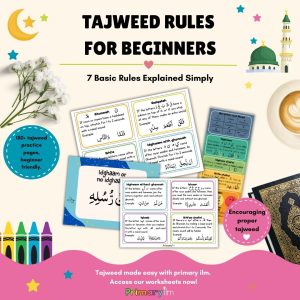
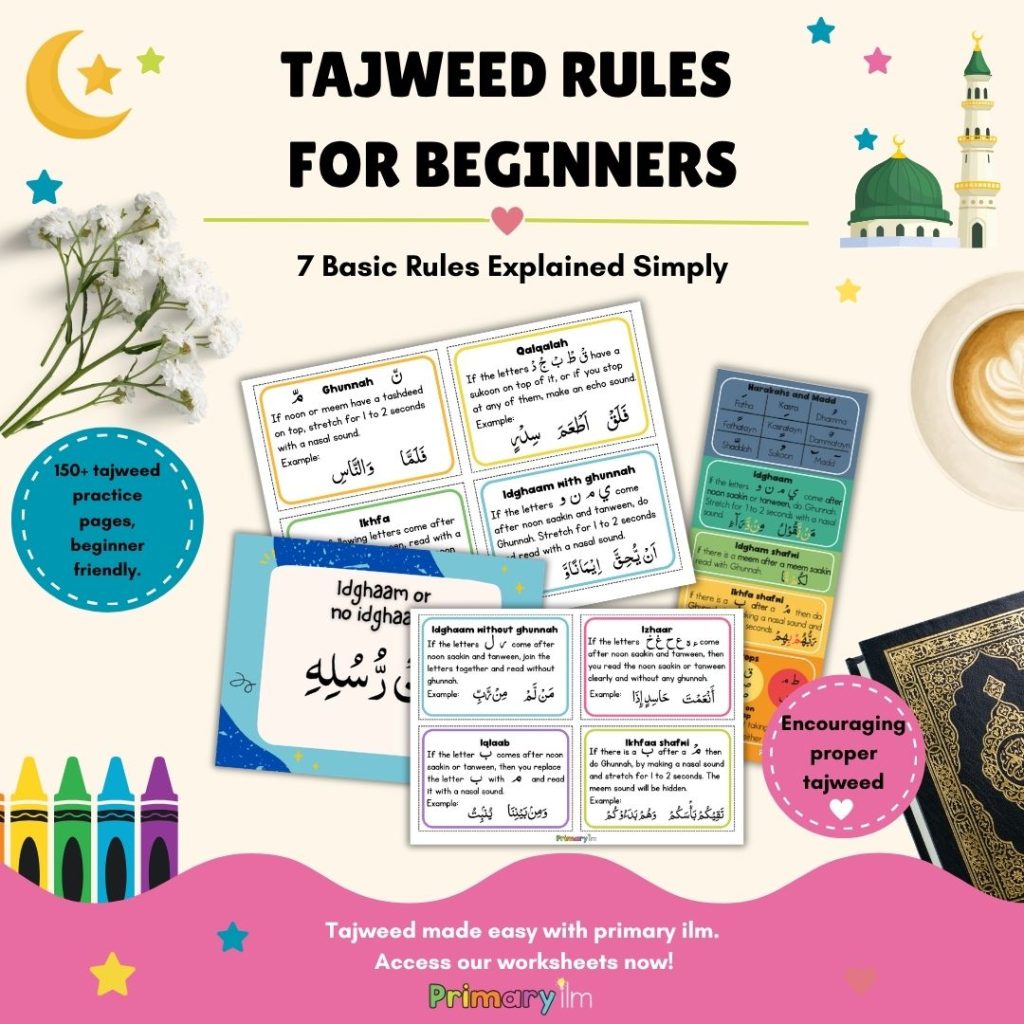
To help children and beginners remember the most important Tajweed rules, we’ve created mini Tajweed Rules PDF downloads which include ghunna, idgham, qalqalah and ikhfa.
They’re designed to make learning simple and includes:
- Beginner-friendly explanations
- Easy-to-follow examples
- Child-friendly layout
Download all of the pages when you get the yearly access and use it as a helpful reference while learning.

Frequently Asked Questions
What are the basic Tajweed rules?
Some of the first Tajweed rules beginners learn include Makharij, Noon Sakinah, Meem Sakinah, Qalqalah, Ghunnah, Madd, and heavy and light letters.
How many Tajweed rules are there?
There are many Tajweed rules, but beginners don’t need to learn them all at once. Start with the foundational rules and gradually build your knowledge over time.
Can I learn Tajweed by myself?
You can begin learning Tajweed independently using books, videos and printable resources. However, learning with a qualified teacher is recommended so your pronunciation can be corrected.
How long does it take to learn Tajweed?
Everyone learns at a different pace. With regular practice and guidance, most beginners gradually become more confident over several months.
What is the best way to learn Tajweed?
The best approach is to learn one rule at a time, practise consistently, listen to experienced reciters and receive feedback from a qualified teacher.
Final thoughts
Learning Tajweed is one of the most rewarding journeys a Muslim can take.
Every letter recited correctly is an effort to preserve the beautiful words of Allah exactly as they were revealed.
Don’t worry about learning every rule immediately.
Take small, consistent steps.
Learn one rule.
Practise it regularly.
Then move on to the next.
Over time, those small improvements become confident and beautiful Qur’an recitation.
Continue Your Child’s Islamic Learning Journey
Looking for more Islamic resources?
✓ Browse our growing collection of free resources by creating a free account.
✓ Join our monthly mailing list for free downloads, updates and new resources.
✓ Explore the Primary Ilm Membership for access to 3,000+ Islamic worksheets, activities, presentations and printables.
✓ Follow us on Instagram and Pinterest for ideas and inspiration.