When children first begin learning Arabic, recognising the letters is only the beginning.
The next step is learning how those letters sound.
This is where Fatha, Kasra and Damma come in.
These three small marks are some of the first Arabic vowel signs children learn. Once they understand them, they can begin moving from simply recognising letters to actually reading simple Arabic sounds and words.
If your child knows the Arabic alphabet but is unsure why بَ, بِ and بُ all sound different, this guide will help explain Fatha, Kasra and Damma simply.
Contents
What Are Fatha, Kasra and Damma?
What Is Fatha in Arabic?
What Is Kasra in Arabic?
What Is Damma in Arabic?
How Fatha, Kasra and Damma Change a Letter
Fatha, Kasra and Damma Examples
Fatha, Kasra and Damma Words
What Comes After Fatha, Kasra and Damma?
How to Teach Fatha, Kasra and Damma to Kids
Fatha, Kasra and Damma Worksheets
Frequently Asked Questions
What Are Fatha, Kasra and Damma?
Fatha, Kasra and Damma are short vowel marks used in Arabic.
They are placed above or below an Arabic letter and tell us which short vowel sound to make.
The three sounds are:
Fatha — a
Kasra — i
Damma — u
So instead of a child only recognising the letter ب as baa, they begin learning how it changes when a vowel mark is added:
بَ — ba
بِ — be
بُ — bu
This is an important step towards learning to read Arabic and, eventually, the Qur’an.
What Is Fatha in Arabic?
A Fatha (فَتْحَة) is a small line written above an Arabic letter.
It gives the letter a short “a” sound.
For example:
بَ — ba
تَ — ta
جَ — ja
دَ — da
A simple way to explain it to a child is:
“Fatha goes on top and makes an ‘a’ sound.”
At this stage, keep the sound short. Children can sometimes stretch it into “baa”, but Fatha itself produces a short vowel sound: ba, not baa.
What Is Kasra in Arabic?
A Kasra (كَسْرَة) is a small line written underneath the letter.
It gives the letter a short “i” sound.
For example:
بِ — bi
تِ — ti
جِ — ji
دِ — di
You could teach children:
“Kasra goes underneath and makes an ‘i’ sound.”
Once children are comfortable with Fatha, introducing Kasra helps them realise that the same Arabic letter can make different sounds depending on the vowel mark attached to it.
What Is Damma in Arabic?
A Damma (ضَمَّة) is a small curled mark written above the Arabic letter.
It gives the letter a short “u” sound.
For example:
بُ — bu
تُ — tu
جُ — ju
دُ — du
Children may need a little more practice recognising Damma because its shape looks different from Fatha and Kasra.
A simple reminder is:
“Damma goes on top and makes a ‘u’ sound.”
How Fatha, Kasra and Damma Change a Letter
One of the easiest ways to teach these Arabic vowel marks is to use the same letter with all three.
Take ب:
بَ — ba
بِ — bi
بُ — bu
The letter itself hasn’t changed.
Only the vowel mark has changed.
Now try ت:
تَ — ta
تِ — ti
تُ — tu
Or م:
مَ — ma
مِ — mi
مُ — mu
This is why I think it’s helpful to teach Fatha, Kasra and Damma through lots of repeated reading rather than expecting children simply to memorise what each mark is called.
The goal is for them to eventually see بِ and immediately read bi, without having to stop and think:
“That’s a Baa… it has a Kasra… Kasra says i…”
That fluency comes with practice.
Fatha, Kasra and Damma Examples
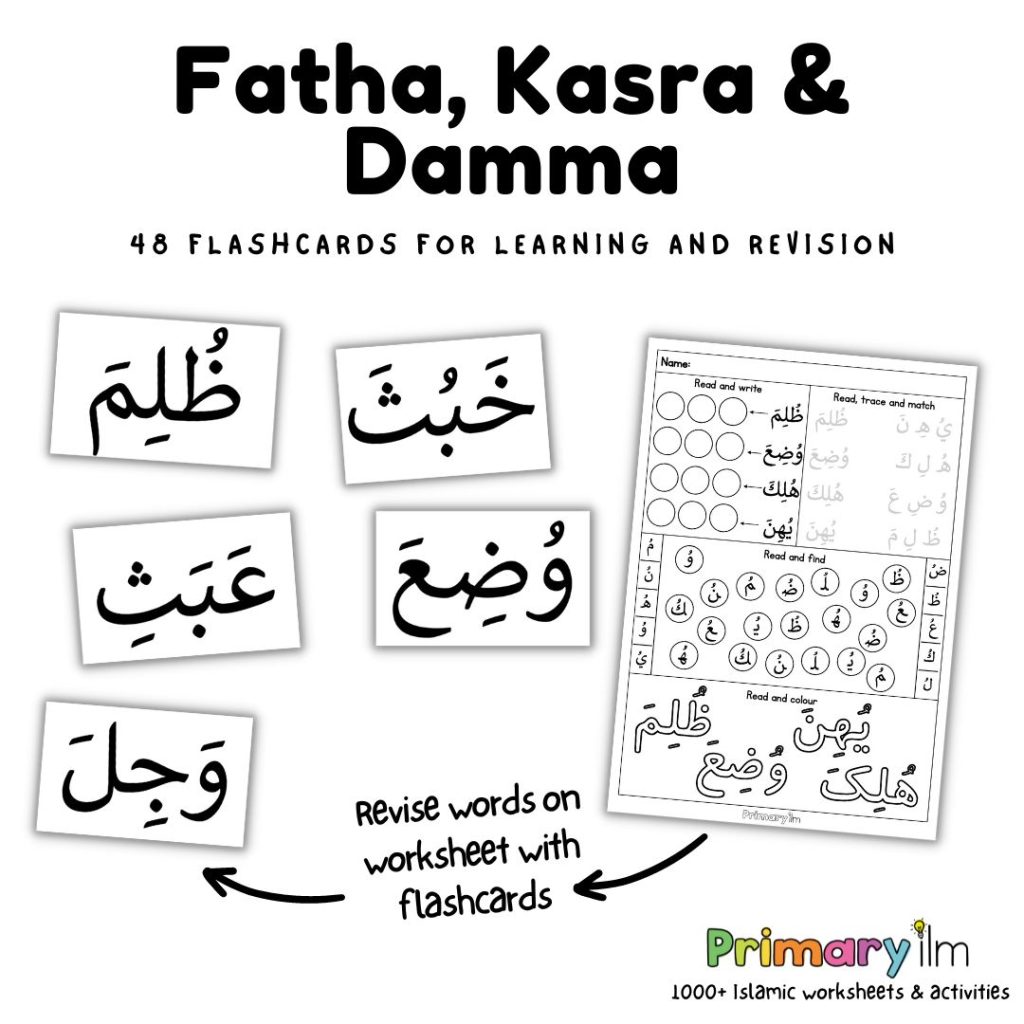
Here are a few simple examples you can practise together. You can write these on a whiteboard or use a qaida which has plenty of practice pages.
With Fatha:
بَ — ba
تَ — ta
ثَ — tha
نَ — na
مَ — ma
With Kasra:
بِ — bi
تِ — ti
ثِ — thi
نِ — ni
مِ — mi
With Damma:
بُ — bu
تُ — tu
ثُ — thu
نُ — nu
مُ — mu
Begin slowly.
You could read the sounds first and ask your child to repeat them.
Later, point to them in a random order and see whether your child can identify the sound independently.
You don’t necessarily need to teach all the letters with all three vowel marks in one sitting.
For younger children especially, that can quickly become overwhelming.
Try a handful of letters at a time.
Once those are becoming secure, add a few more.
Fatha, Kasra and Damma Words
Eventually, children need to move beyond reading individual letters.
This is where the real progress begins.
For example, instead of practising:
بَ
تَ
كَ
in isolation, children begin seeing short combinations of letters and blending the sounds together.
This can sometimes be a tricky transition.
A child may be perfectly confident saying ba, bi and bu individually, but become unsure when several letters appear together.
That’s normal.
Start with very short combinations and encourage your child to sound them out slowly before blending them together.
The aim is to help them understand:
Arabic letters + vowel marks = sounds that can be blended into words.
What Comes After Fatha, Kasra and Damma?
Once children are confident reading Arabic letters with the three short vowels, they can gradually move on to other Arabic reading concepts.
These might include:
Sukoon — where a letter has no vowel sound.
Tanween — the doubled vowel marks that produce an, in and un sounds.
Shaddah — showing that a consonant is doubled.
Long vowel sounds — using letters such as Alif, Waw and Yaa.
There is no need to rush through all of these.
A strong understanding of the basics makes everything that comes afterwards much easier.
How to Teach Fatha, Kasra and Damma to Kids
Keep it simple.
Children don’t need a long explanation about Arabic grammar when they’re first learning.
Start with:
Fatha = a
Kasra = i
Damma = u
Then practise.
Use one letter with all three vowels
For example:
بَ بُ بِ
Ask:
“Which one says ba?”
“Can you find bu?”
“Point to bi.”
Mix them up
Once your child knows them in order, change the order.
Otherwise, they may simply memorise a pattern rather than actually recognising each vowel mark.
Use short daily practice
Five or ten minutes regularly can be much more effective than sitting down for a long Arabic lesson once a week.
Say the sounds aloud
Arabic reading needs to be heard as well as seen.
Encourage children to repeat the sounds and listen carefully to correct pronunciation.
Move gradually towards blending
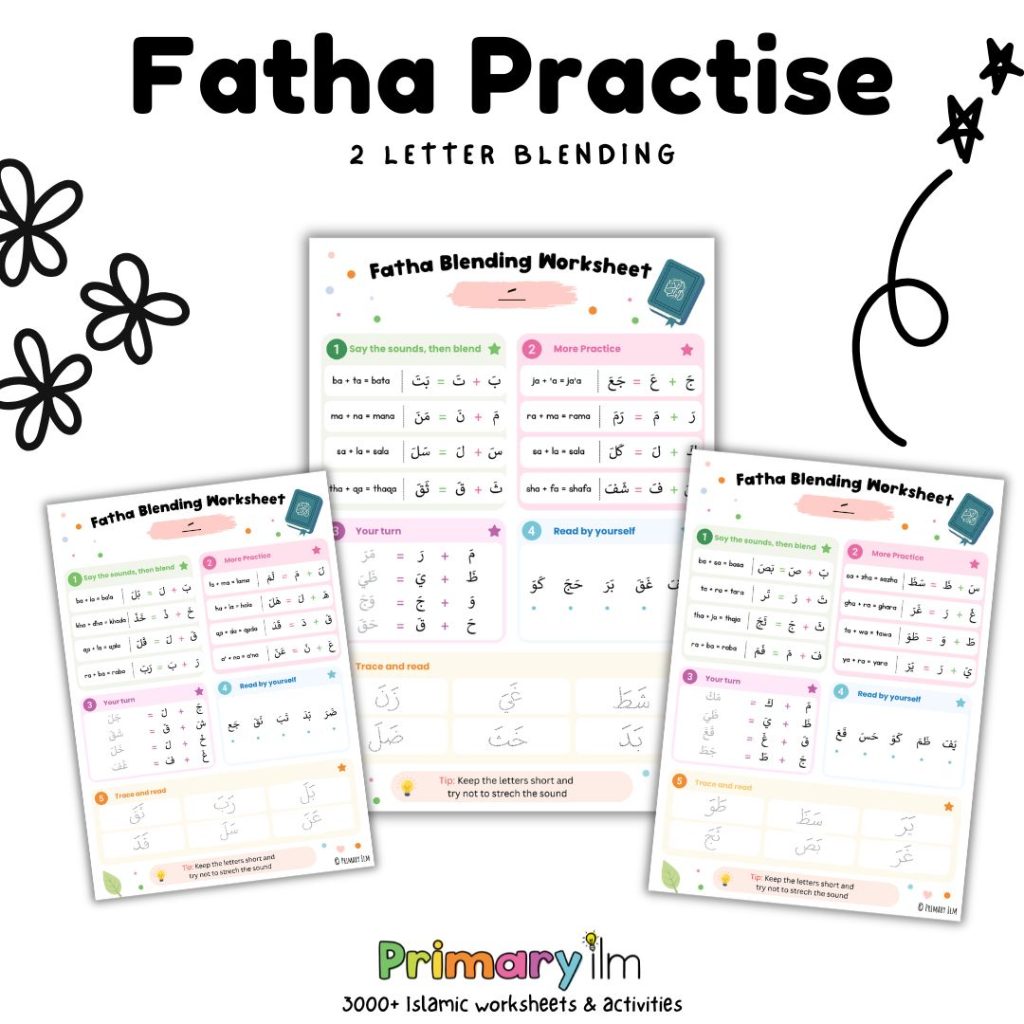
Once individual letters are secure, begin placing two letters together.
This helps bridge the gap between recognising vowel sounds and actually reading.
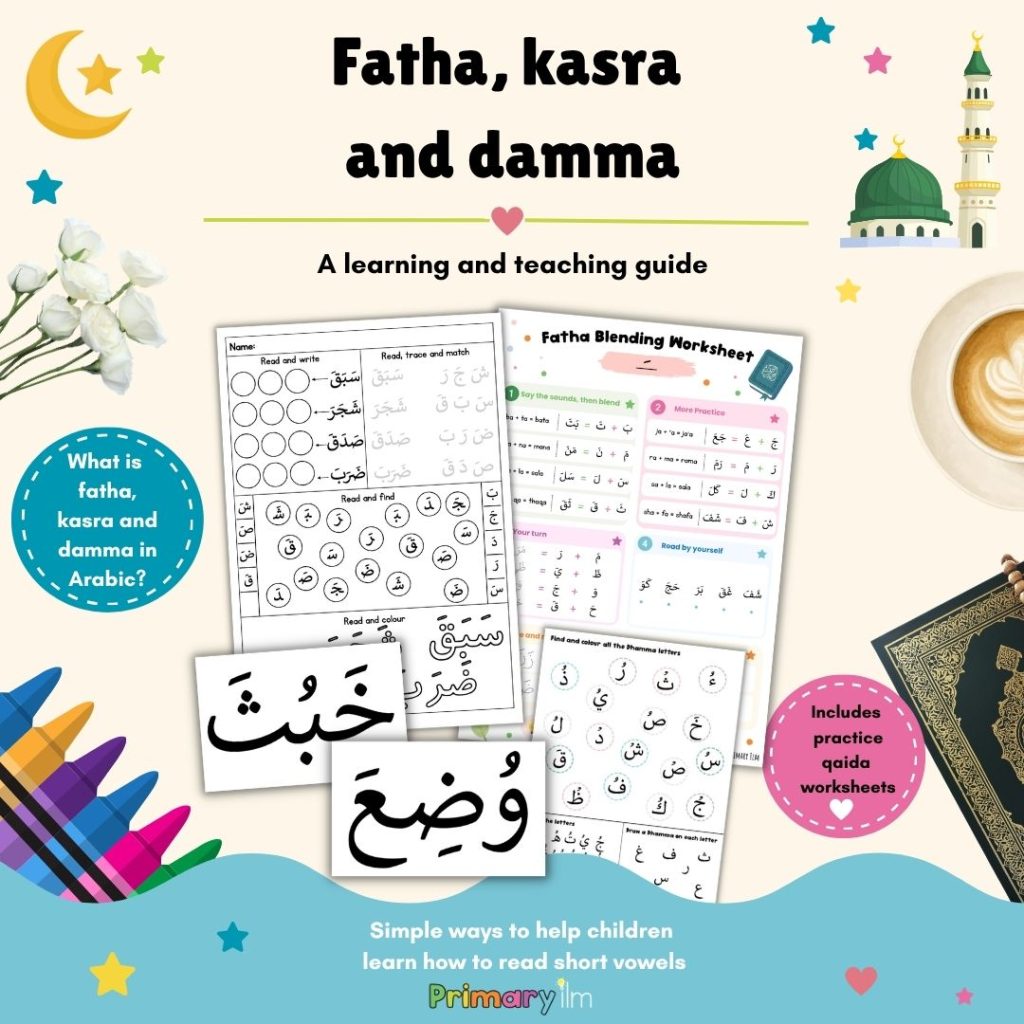
Fatha, Kasra and Damma Worksheets
Worksheets can be particularly useful at this stage because children need plenty of repetition.
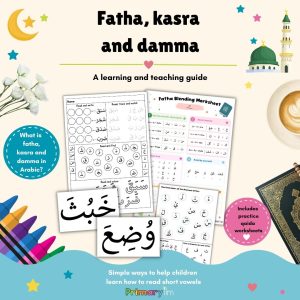
A good Fatha Kasra Damma worksheet might include activities such as:
Matching letters to their correct sounds.
Adding the correct vowel mark.
Reading letters with Fatha, Kasra and Damma.
Sorting sounds into a, i and u groups.
Finding a particular vowel mark.
Tracing and reading Arabic letters.
Blending two letters together.
At Primary Ilm, our Arabic worksheets are designed to give children this repeated practice without every activity feeling exactly the same.
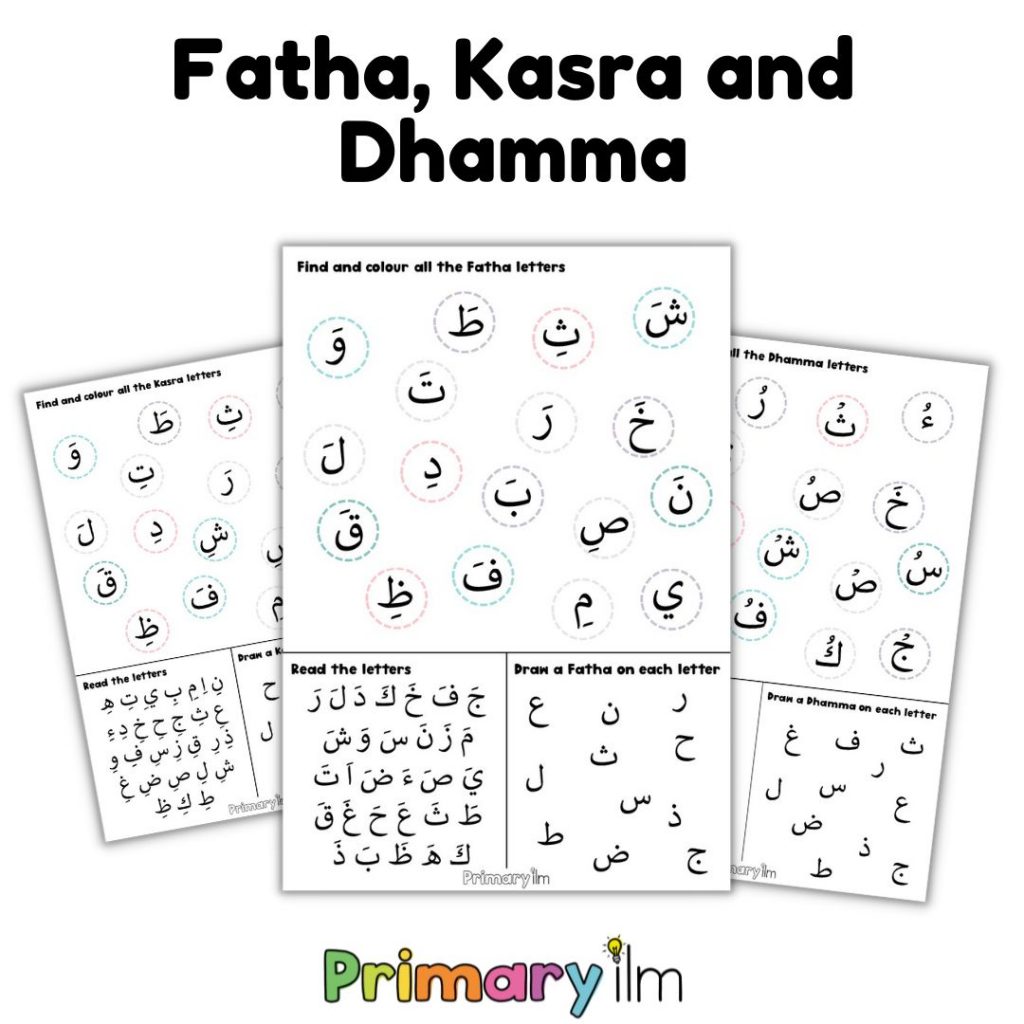
You can use them alongside your child’s Qaida or Arabic lessons to reinforce what they’re already learning.
Frequently Asked Questions
What are Fatha, Kasra and Damma called?
Fatha, Kasra and Damma are Arabic short vowel marks, also known as harakat.
What sound does Fatha make?
Fatha makes a short “a” sound.
For example:
بَ — ba
What sound does Kasra make?
Kasra makes a short “i” sound.
For example:
بِ — bi
What sound does Damma make?
Damma makes a short “u” sound.
For example:
بُ — bu
Where are Fatha, Kasra and Damma placed?
Fatha is written above the letter.
Kasra is written underneath the letter.
Damma is written above the letter.
How can I teach Fatha, Kasra and Damma to my child?
Begin with one vowel at a time, practise it on familiar Arabic letters and then mix the three together. Once your child can recognise the sounds confidently, begin practising short letter combinations and simple blending.
Final Thoughts
Fatha, Kasra and Damma may look like tiny marks, but learning them is a big step in a child’s Arabic reading journey.
This is where letters begin turning into sounds.
And sounds eventually begin turning into words.
If your child is taking a little while to remember the difference between ba, bi and bu, don’t worry.
Keep practising.
Keep the sessions short.
Revisit the same sounds regularly.
And don’t rush onto the next stage before the foundations feel secure.
With enough repetition, those little vowel marks that once needed lots of thought gradually become something children recognise automatically and that confidence makes the next stage of Arabic reading much easier.
Continue Your Child’s Islamic Learning Journey
Looking for more Islamic resources?
✓ Browse our growing collection of free resources by creating a free account.
✓ Join our monthly mailing list for free downloads, updates and new resources.
✓ Explore the Primary Ilm Membership for access to 3,000+ Islamic worksheets, activities, presentations and printables.
✓ Follow us on Instagram and Pinterest for ideas and inspiration.