

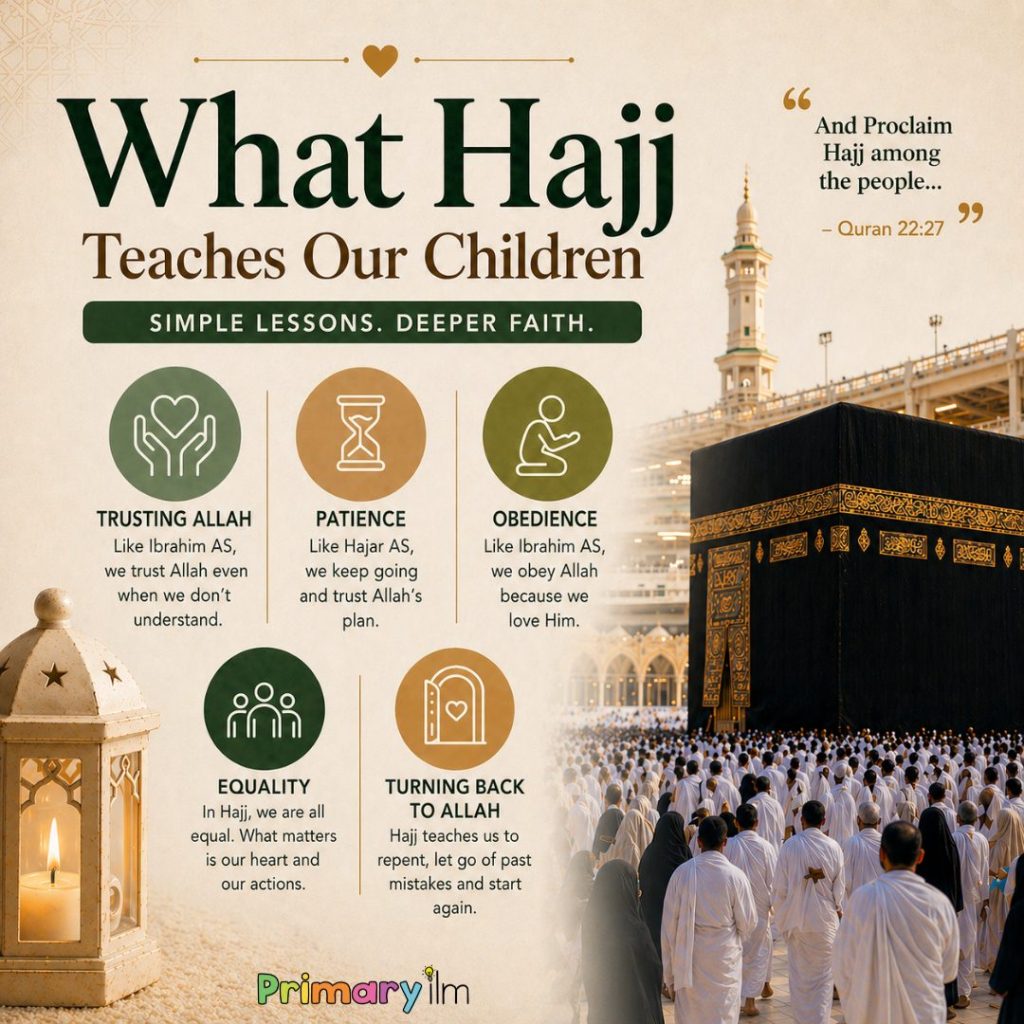
When we think about Hajj, we often focus on explaining what happens.
But beyond the actions…
Hajj is full of powerful lessons.
And these lessons are something our children can understand, even if they are not going.
Teaching the lessons of Hajj to children helps them connect to Islam in a deeper and more meaningful way.
Why Teaching the Lessons of Hajj Matters
Children may not remember every step of Hajj.
But they will remember:
- how it made them feel
- the stories behind it
- the meaning it carried
That’s why focusing on lessons is so powerful.
It moves learning from information to connection.
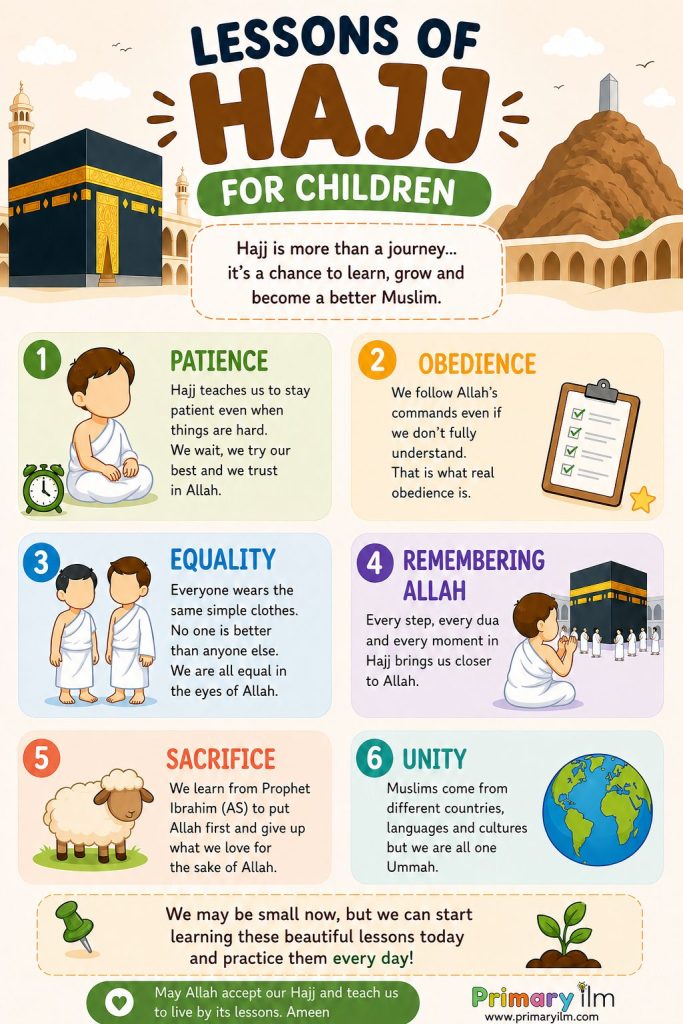
Simple Lessons of Hajj for Children
Here are some key lessons you can gently introduce:
1. Trusting Allah
One of the most beautiful lessons of Hajj is learning to trust Allah.
Not when things are easy…
but when they are uncertain.
Think about Prophet Ibrahim (AS).
He was asked to leave his family in the desert.
No water. No people. No clear outcome.
And he didn’t question.
He trusted.
You can say:
“Sometimes we don’t understand everything, but we trust Allah knows what is best.”
Trusting Allah doesn’t mean doing nothing.
It means:
- trying your best
- staying hopeful
- and knowing Allah is always taking care of you
2. Patience
Hajj requires patience:
- long journeys
- waiting
- effort
When we teach children about patience, one of the most powerful stories is that of Prophet Ibrahim (AS).
He was tested in ways that are hard for us to imagine.
He was asked to:
- leave his wife and baby in the desert
- follow Allah’s command without knowing the outcome
And yet…
He remained patient.
He trusted Allah completely.
You can explain this simply to a child:
“Even when things were really hard, Prophet Ibrahim (AS) trusted Allah and stayed patient.”
Another beautiful example is Hajar (AS).
She was left in the desert with her baby, Prophet Ismail (AS), with very little.
She ran between the hills of Safa and Marwah, searching for water.
Again and again.
This is what we remember in Hajj when Muslims perform Sa’i.
Her story teaches children:
- to keep trying
- to not give up
- to trust that Allah will provide
A simple way to explain:
“Hajar (AS) didn’t stop trying — and Allah helped her in the end.”
Sometimes children think patience means doing nothing.
But these stories show something different.
Patience means:
- continuing to try
- staying calm
- trusting Allah even when things feel difficult
3. Obedience to Allah
Hajj teaches us something very simple:
We follow Allah’s commands, even when we don’t fully understand them.
Think about Prophet Ibrahim (AS).
When Allah asked him to do something difficult…
he didn’t delay.
He didn’t argue.He obeyed.
And this is what made him so beloved to Allah.
We teach our children:
“We do what Allah asks because we love Him, not just because we have to.”
Obedience isn’t about pressure.
It’s about:
- love
- trust
- and wanting to please Allah
Sometimes, the simplest acts (done for Allah) are the most powerful.
4. Equality
One of the most powerful things about Hajj is how everyone looks the same.
People from all over the world stand together.
Different languages. Different backgrounds. Different lives.
But in Hajj…
There is no difference.
Everyone wears simple clothing.
No one stands out for:
- wealth
- status
- appearance
This teaches our children:
“In front of Allah, we are all equal.”
It reminds us that what truly matters is not how we look…
But:
- our hearts
- our actions
- and our connection to Allah
And that is something every child can understand.
5. Letting Go and Turning Back to Allah
Hajj is also about:
- asking for forgiveness
- starting fresh
You can explain:
“Allah always gives us a chance to try again.”
How to Teach These Lessons in Daily Life
You don’t need a formal lesson.
Instead, use small moments:
- during conversations
- at bedtime
- while reading stories
Ask simple questions like:
- “What do you think trusting Allah means?”
- “When was it hard to be patient?”
These moments build understanding naturally.
Making It Easier for You
If you want help turning these lessons into something your child will actually engage with, I’ve created resources to support you.
These include:
- simple explanations
- engaging activities
- child-friendly learning tools
👉 [Explore the resources here]
Final thoughts
Hajj is more than a journey.
It’s a collection of lessons that shape the heart.
And when we pass these lessons on to our children…
We are helping them build a connection to Islam that lasts.
Sign up to our monthly mailing list below to receive free downloads and updates. Register to access the free resources that are available to download on our website here. Follow along on instagram and Pinterest for instant updates on resources. Looking to join the Primary ilm membership, click here!



2 responses
May Allah bless the workof your hands…amiiiin
Ameen