Surah Al-Falaq is the 113th chapter of the Quran. It contains just five short verses, yet it carries one of the most powerful messages in all of Islamic practice; that we turn to Allah alone for protection from every form of harm.
It is one of the Al-Mu’awwidhatayn (the two surahs of refuge), recited alongside Surah An-Naas. Together with Surah Al-Ikhlas, these three surahs form the morning and evening adhkar and are recommended before sleeping.
In this guide you’ll find the full Arabic text, Surah Al-Falaq transliteration, English translation, and a clear explanation of each verse’s meaning.
Contents
Click on the text to take you to the relevant section:
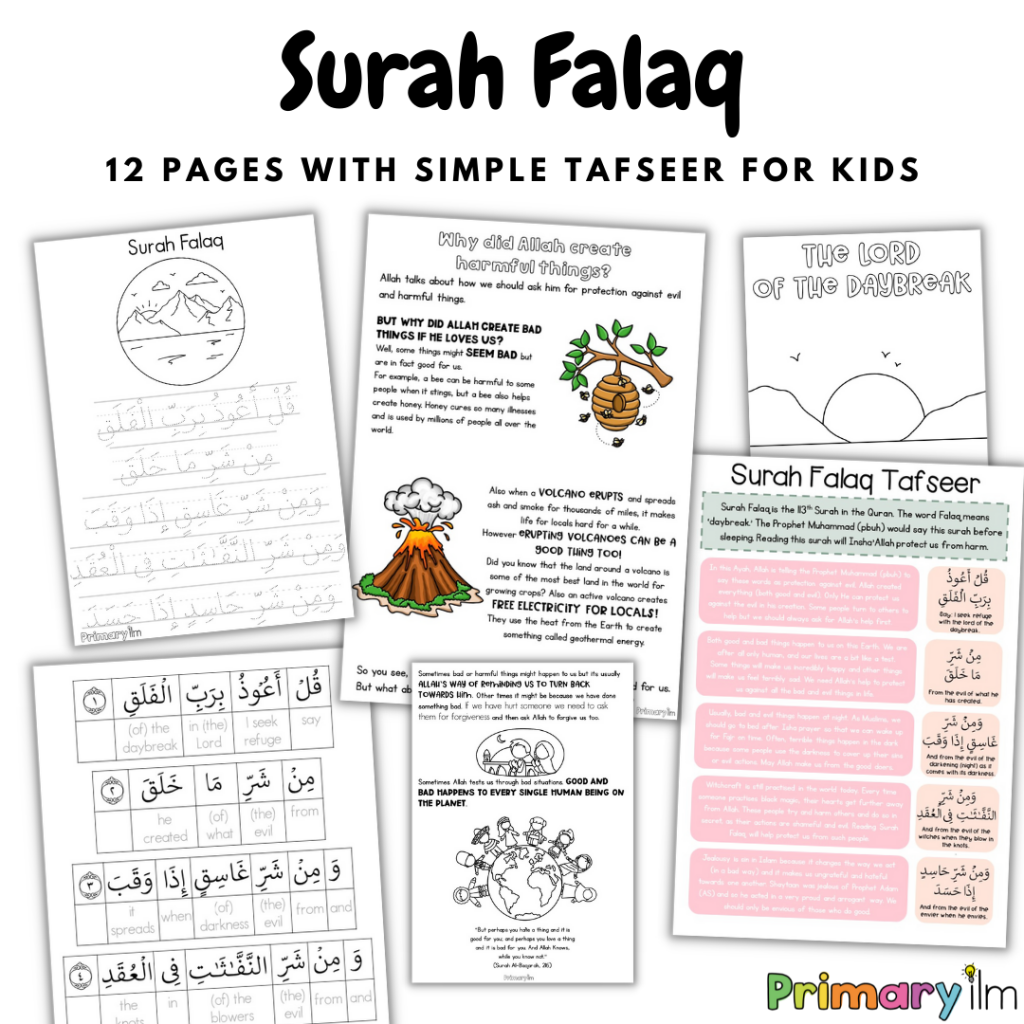
Free Surah Al-Falaq Transliteration, Tafseer and Translation for kids
Surah Al-Falaq Transliteration
Surah Al-Falaq Translation in English
How to Teach Surah Al-Falaq to Children
More Surah Resources from Primary Ilm
Free Surah Al-Falaq Transliteration, Tafseer and Translation for kids


Surah Al-Falaq in Arabic
قُلْ أَعُوذُ بِرَبِّ الْفَلَقِ
مِن شَرِّ مَا خَلَقَ
وَمِن شَرِّ غَاسِقٍ إِذَا وَقَبَ
وَمِن شَرِّ النَّفَّاثَاتِ فِي الْعُقَدِ
وَمِن شَرِّ حَاسِدٍ إِذَا حَسَدَ
Surah Al-Falaq Transliteration
Qul a’oodhu bi rabbil-falaq
Min sharri ma khalaq
Wa min sharri ghasiqin idha waqab
Wa min sharrin-naffathati fil-‘uqad
Wa min sharri hasidin idha hasad
Surah Al-Falaq Translation in English
Say, “I seek refuge in the Lord of daybreak,
From the evil of that which He created,
And from the evil of darkness when it settles,
And from the evil of those who blow on knots,
And from the evil of an envier when he envies.”
Surah Al-Falaq Meaning (Verse by Verse)
Ayah 1: “Say, I seek refuge in the Lord of daybreak.”
Allah commands the Prophet ﷺ — and through him, all of us — to actively seek protection. The word Al-Falaq refers to the breaking of dawn: the moment darkness splits open and light takes over. By choosing this image, Allah reminds us that He is the One who commands light into existence. If He can split the darkness of night, He can protect us from every darkness we face.
Ayah 2: “From the evil of that which He created.”
A sweeping, all-encompassing verse. We ask Allah to protect us from any harm that exists anywhere in His creation — seen or unseen, known or unknown. It is an acknowledgement that we cannot anticipate every threat, but Allah can.
Ayah 3: “And from the evil of darkness when it settles.”
Night brings vulnerability — physically, emotionally, spiritually. This verse teaches us to seek Allah’s protection when fear creeps in, when we feel alone, or when the world feels uncertain. It is a reminder that no darkness is beyond His sight or His reach.
Ayah 4: “And from the evil of those who blow on knots.”
This refers to harmful practices including witchcraft and black magic. Rather than approaching such things with fear or fascination, this verse redirects us: turn to Allah. He is the only true protection.
Ayah 5: “And from the evil of an envier when he envies.”
Envy is real, and its effects can cause genuine harm. This verse acknowledges that — and gives us the right response. We do not retaliate, obsess, or fear. We ask Allah for protection and trust in Him completely.
What Is Surah Al-Falaq About?
At its heart, Surah Al-Falaq is a dua of complete reliance on Allah. It moves through five layers of potential harm — all of creation, the darkness of night, unseen spiritual harm, envy — and responds to each one the same way: seek refuge in Allah.
That simplicity is the point. No matter what threatens us, the answer is the same.
When to Recite Surah Al-Falaq
The Prophet ﷺ recited Surah Al-Falaq, Surah An-Naas, and Surah Al-Ikhlas:
- Every morning and evening as part of the adhkar
- Before sleeping, blowing into the hands and wiping over the body three times
- During illness — it is reported that the Prophet ﷺ recited these surahs when he was unwell
Making this a consistent daily habit helps build a genuine sense of tawakkul — trust in Allah as the ultimate protector.
How to Teach Surah Al-Falaq to Children
Children memorise more deeply when they understand what they’re saying. Here are some practical ways to bring this surah to life:
- Learn one ayah at a time — listen, repeat, understand, move on
- Discuss the meaning simply: “This is us asking Allah to keep us safe from anything scary or harmful.”
- Connect it to their world — fears of the dark, worrying about others being mean; this surah speaks to all of it
- Use activity sheets — matching, colouring, and reflection activities make memorisation stick
- Make it a bedtime habit — reciting together before sleep turns learning into lived practice
Frequently Asked Questions
What does Surah Al-Falaq mean?
It is a prayer seeking Allah’s refuge from all forms of evil. Harm from creation, darkness, witchcraft, and envy.
When should Surah Al-Falaq be recited?
Morning and evening adhkar, and before sleeping. It is also recommended during illness.
What is the difference between Surah Al-Falaq and Surah An-Naas?
Surah Al-Falaq seeks protection from external harms — darkness, envy, and magic. Surah An-Naas seeks protection from internal harm (specifically the whisperings of Shaytan into the heart.)
Is Surah Al-Falaq in the Mu’awwidhatayn?
Yes. Surah Al-Falaq and Surah An-Naas together are known as the Al-Mu’awwidhatayn (the two surahs of refuge.)
More Surah resources from Primary ilm
If you found this guide helpful, our membership gives you access to thousands of Islamic resources for parents, homeschoolers, teachers, and Islamic schools including:
- Child-friendly Quran activity booklets
- Tafsir and reflection worksheets
- Full Islamic curriculum units
- Halaqa presentations
- Arabic learning resources
- 3,500+ Islamic worksheets and activities
Explore the Primary Ilm Membership
Sign up to our monthly mailing list below to receive free downloads and updates. Register to access the free resources that are available to download on our website here. Follow along on instagram and Pinterest for instant updates on resources. Looking to join the Primary ilm membership, click here!