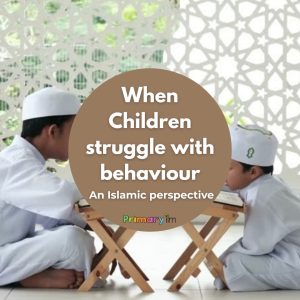

When children struggle with behaviour, it can leave parents feeling worried, frustrated, or even guilty. We may wonder whether we’re doing enough, saying the right things, or guiding our children correctly.
From an Islamic perspective, it’s important to remember that behaviour is often a signal, not a verdict. It tells us something about what a child is still learning, processing, or needing support with.
Islam invites us to look beyond outward actions (not dismissing them) but recognising that behaviour often reveals what is happening in the heart.
Behaviour Is Not the Same as Akhlaq
A child struggling with behaviour does not automatically lack good akhlaq.
Children are still developing:
- emotional regulation
- impulse control
- patience
- empathy
- self-awareness
These skills take time, repetition, and gentle guidance.
Akhlaq is about who a child is becoming, not how they behave in a single moment. Islam teaches us to nurture character gradually, with wisdom and mercy.
The Prophet ﷺ and Compassionate Guidance
The Prophet ﷺ consistently responded to mistakes with patience and understanding. He corrected with wisdom, not harshness. We should recognise that people (especially children) learn through experience.
On one occasion, the Prophet ﷺ was leading the prayer when he heard a child crying. He shortened the prayer out of consideration for the child and their mother.
Later, he explained that he did not want to cause hardship or distress.
This moment is powerful because the Prophet ﷺ did not criticise the child for crying, nor did he expect the child to behave beyond their capacity. Instead, he recognised the needs and limitations of a child and adjusted his response with mercy.
This example shows that in Islam, guidance is paired with understanding. Behaviour is acknowledged, but compassion comes first, especially when a child is still developing emotionally.
Anas ibn Malik (رضي الله عنه) served the Prophet ﷺ for ten years from a young age. Reflecting on that time, Anas said:
“He never once said ‘uff’ to me nor did he ever say, ‘Why did you do that?’ (Bukhari and Muslim)
This does not mean that the Prophet ﷺ ignored mistakes or behaviour. Rather, it shows his deep understanding of a child’s stage of learning and his commitment to nurturing character through patience and mercy.
It reminds us that when children struggle with behaviour, an Islamic response considers:
- the child’s age and capacity
- their emotional state
- and the impact of our response on their heart
Correction, when needed, is guided by mercy and wisdom, not frustration. When children struggle with behaviour, our response can either help them learn… or shut them down.
Asking Better Questions When Behaviour Is Difficult
Instead of immediately asking:
“Why are they behaving like this?”
Islamic guidance teaches us to consider both outward actions and inward states.
The Prophet ﷺ corrected behaviour while also taking into account intention, understanding, and circumstance. This balance between justice and mercy is at the heart of Islamic tarbiyah.
When children struggle, this perspective leads us to ask:
• What quality of character is still developing?
• What feeling or need is influencing this behaviour?
• How can correction be paired with mercy and wisdom?
In this way, behaviour becomes a starting point for guidance and not the end of the conversation.
Naming Values Instead of Only Correcting Actions
One powerful way to guide children is by naming the value behind the behaviour we’re addressing.
For example:
- “Let’s be gentle.”
- “This is a moment for patience.”
- “What would the Prophet ﷺ do in this situation?”
- “How can we fix this kindly?”
These phrases help children connect actions to Islamic values, rather than seeing rules as arbitrary. Over time, this builds internal motivation rather than fear-based compliance.
Making Dua for Our Children and Ourselves
Alongside guidance and boundaries, Islam reminds us of the importance of turning to Allah.
Akhlaq is ultimately shaped by Allah. Our role is to try, to guide, and to rely on Him.
Making dua:
- for our children’s patience and kindness
- for our own calm and wisdom
- for mercy within our homes
…keeps us grounded and hopeful.
When children hear us making dua for good character (especially aloud) they learn that akhlaq matters and that we seek Allah’s help in becoming better people.
Progress Takes Time and That’s Okay
When children struggle with behaviour, it can feel exhausting. But character is not built overnight.
Islamic parenting is not about perfect behaviour. It’s about:
- consistency
- compassion
- reflection
- and steady growth
Every calm response, every gentle reminder, and every sincere dua contributes to your child’s development even when progress feels slow.
Final Reflection
From an Islamic perspective, behaviour struggles are not failures. They are moments for teaching, guiding, and nurturing hearts.
May Allah help us respond with wisdom, raise children with beautiful akhlaq, and grant us patience in the journey insha’Allah.
Sign up to our monthly mailing list below to receive free downloads and updates. Register to access the free resources that are available to download on our website here. Follow along on instagram and Pinterest for instant updates on resources. Looking to join the Primary ilm membership, click here!